Sort, cut and fold shapes
This Grade 1 worksheet practises sorting shapes by one feature, taking a shape apart into smaller shapes, testing shapes for matching halves by folding and drawing shapes in a new size and position (Alberta Geometry 1).
- Grade 1
- Geometry
- 2 pages + 1-page answer key
- Alberta curriculum (2022)
- 6 free versions
Every PDF includes the answer key
8 questions on 2 pages, plus a 1-page answer key · each version has different numbers · Print from the browser
Need a different skill or more questions?
Make a new worksheet in seconds, with its answer key.
About this worksheet
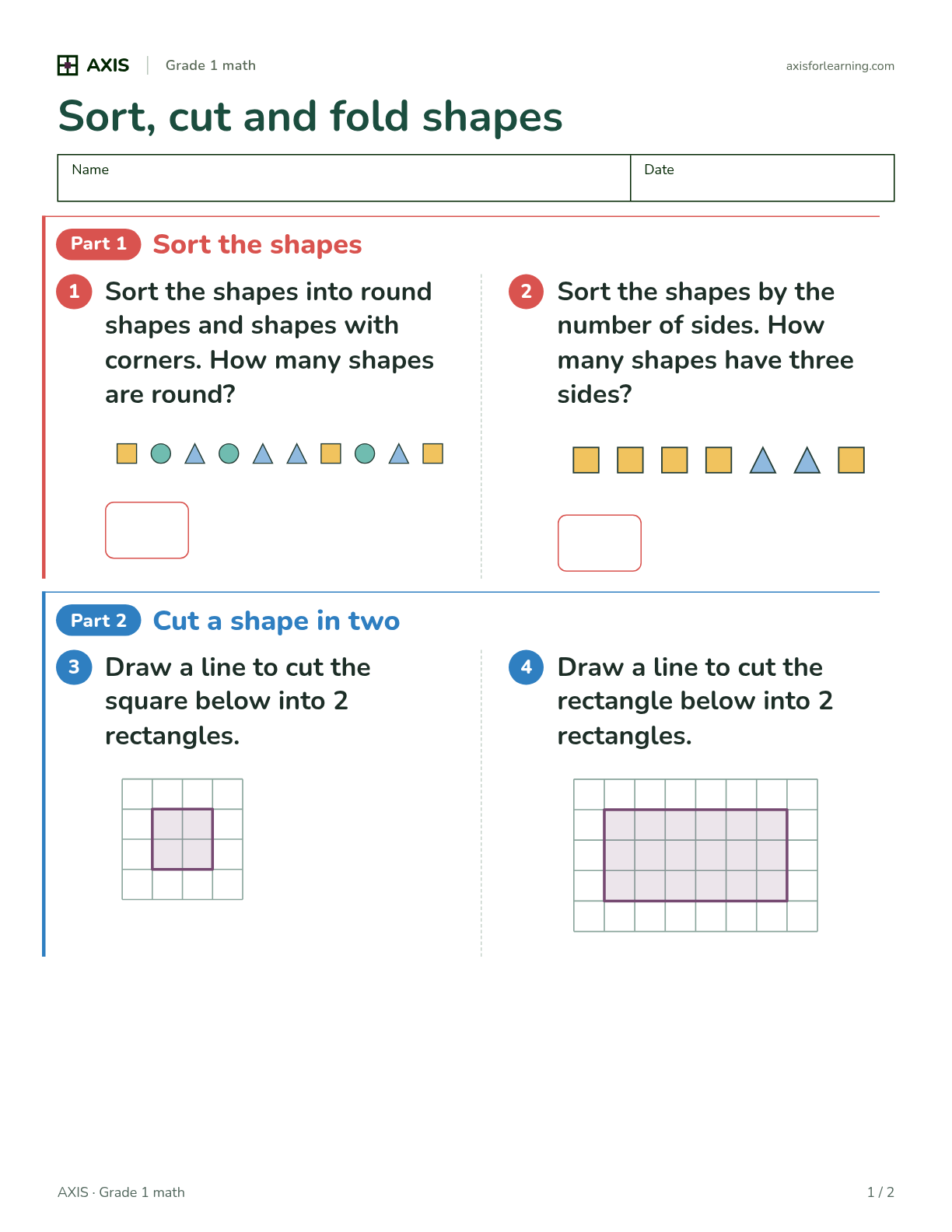
An Alberta Grade 1 shapes worksheet with 8 questions in four parts. Children sort a set of shapes by one feature, such as round or with corners or by the number of sides, and count one group. They draw one line to cut a shape into two smaller named shapes, such as two rectangles or two triangles, and decide whether a shape made of squares can be folded so its two halves match. Last, they draw a named shape again in a new size and turned a new way. It prints as two student pages and a one-page answer key.
What's inside this worksheet
- Part 1
Sort the shapes
Questions 1–2. A row of shapes and a rule: round or with corners, or by the number of sides. Children sort them and write how many are in one group.
- Part 2
Cut a shape in two
Questions 3–4. A shape on a grid. Children draw one straight line to cut it into the two named shapes, such as 2 rectangles or 2 triangles.
- Part 3
Fold to match
Questions 5–6. A shape made of squares. Children decide whether it can be folded so its two halves match.
- Part 4
Draw another
Questions 7–8. A square, rectangle or triangle on dot paper. Children draw another one, a new size and turned a new way.
Curriculum objectives covered
Alberta Kindergarten to Grade 6 Mathematics (2022)
The outcome in short: Explore flat shapes and solids in different sizes and positions, sort them by one feature, put them together and take them apart, and find lines of symmetry by folding. Official wording ↗
On this sheet: Children sort shapes by one feature (Part 1), take a shape apart into smaller shapes (Part 2), find matching halves by folding (Part 3) and draw a shape in a different size and position (Part 4).
How teachers use it
- Cut and fold paper
- For Part 3, children can copy a shape onto squared paper, cut it out and fold it. Matching halves line up exactly.
- Ask for the rule
- After Part 1, give a set of shapes and ask a partner to guess your sorting rule. It turns sorting into talk about features.
- Still a triangle?
- In Part 4, ask whether a triangle turned upside down is still a triangle. The answer is part of Alberta's Grade 1 outcome.
Questions teachers ask
- How many problems are on this worksheet?
- 8 questions in 4 parts on 2 pages, with a 1-page answer key at the end.
- What grade and standard is it for?
- Grade 1. Alberta: Geometry 1.
- Can I print more than one version?
- Yes. There are 6 ready-made versions, each with different numbers and its own answer key, and the same version always prints the same. For more, generate a new worksheet in the generator.
- What is a line of symmetry in Grade 1?
- In Grade 1, children find it by folding: a shape has matching halves if it can be folded so the two parts lie exactly on top of each other.
- Do children need scissors?
- No. Every question is answered on the sheet. Cutting and folding paper shapes is a good way to check the answers afterwards.
Need a different skill?
Make your own worksheet for any K–8 skill in seconds, with its answer key.