Teen numbers, facts and the equal sign
This Grade 1 activity guide practises reading a teen number as ten and some ones, explaining the equal sign as both sides being the same amount and recalling addition and subtraction facts to 20, one child at a time (Alberta Number 2).
- Grade 1
- Number
- 1-page guide + class record
- Alberta curriculum (2022)
- 6 free versions
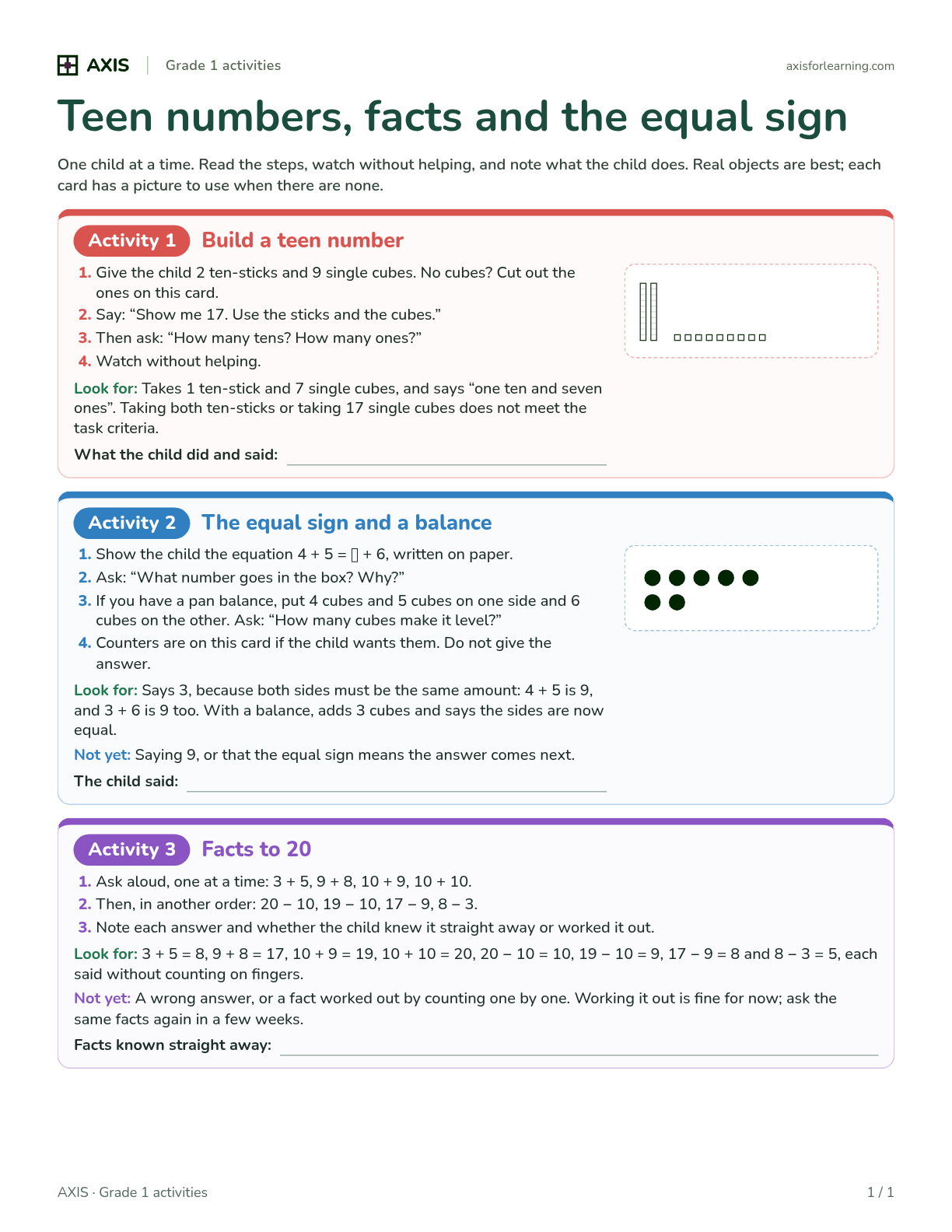
Every activity says what to look for
3 activities on 1 page, plus a class record sheet · each version has different numbers · Print from the browser
About this guide
A teacher's guide to three one-on-one Alberta Grade 1 number activities. The child builds a teen number with ten-sticks and cubes and says how many tens and ones, explains what number makes 4 + 5 = ▢ + 6 true and why, with a pan balance if there is one, and answers addition and subtraction facts to 20 aloud while you note which are known straight away. Each activity is on its own coloured card with the steps, what to look for and what counts as Not yet. A class record sheet comes last.
What's inside this guide
- Activity 1
Build a teen number
The child shows a teen number with ten-sticks and cubes and says how many tens and ones.
- Activity 2
The equal sign and a balance
The child says what goes in the box in 4 + 5 = ▢ + 6 and why, and can check with a pan balance.
- Activity 3
Facts to 20
You ask eight addition and subtraction facts aloud and note which the child knows straight away.
Curriculum objectives covered
Alberta Kindergarten to Grade 6 Mathematics (2022)
The outcome in short: Explore addition and subtraction within 20 through stories, strategies and a balance, find missing numbers, check with the opposite operation, and learn facts to 10 + 10. Official wording ↗
On this sheet: Reading a teen number as one ten and some ones (Activity 1), the equal sign as a balance of two equal amounts (Activity 2) and recalling addition and subtraction facts to 20 (Activity 3).
How teachers use it
- A few children a day
- Take two or three children aside while the class works, and do one or two activities with each. In two weeks every child has done all three.
- Mark the class record
- Tick what a child did on their own, mark Not yet, and write the date. A child marked Not yet can try the same activity again with different numbers from another version.
- Real objects first
- Counters, cubes, blocks and objects from the classroom work best. Cards with a picture can be cut out and used when there are none to hand.
Questions teachers ask
- How many activities are in this guide?
- 3 activities on 1 page, with a class record sheet at the end.
- What grade and standard is it for?
- Grade 1. Alberta: Number 2.
- Can I print more than one version?
- Yes. There are 6 ready-made versions, each with different numbers and objects, and the same version always prints the same. A child marked Not yet can try an activity again from another version.
- Is there a time limit on the facts?
- No. Note whether a child knew a fact straight away or worked it out. Ask the same facts again over the year; recall grows with practice.
- Is there a worksheet to go with them?
- Yes. Teen numbers as ten and some ones, and Equal and not equal, practise the same outcome on paper.
Need a different skill?
Make your own worksheet for any K–8 skill in seconds, with its answer key.