Equal and not equal: = and ≠
This Grade 1 worksheet practises comparing two amounts with = and ≠, deciding whether an equation is true and finding the number that makes both sides equal (Alberta Number 1; Alberta Number 2).
- Grade 1
- Number
- 3 pages + 2-page answer key
- Alberta curriculum (2022)
- 6 free versions
Every PDF includes the answer key
16 questions on 3 pages, plus a 2-page answer key · each version has different numbers · Print from the browser
Need a different skill or more questions?
Make a new worksheet in seconds, with its answer key.
About this worksheet
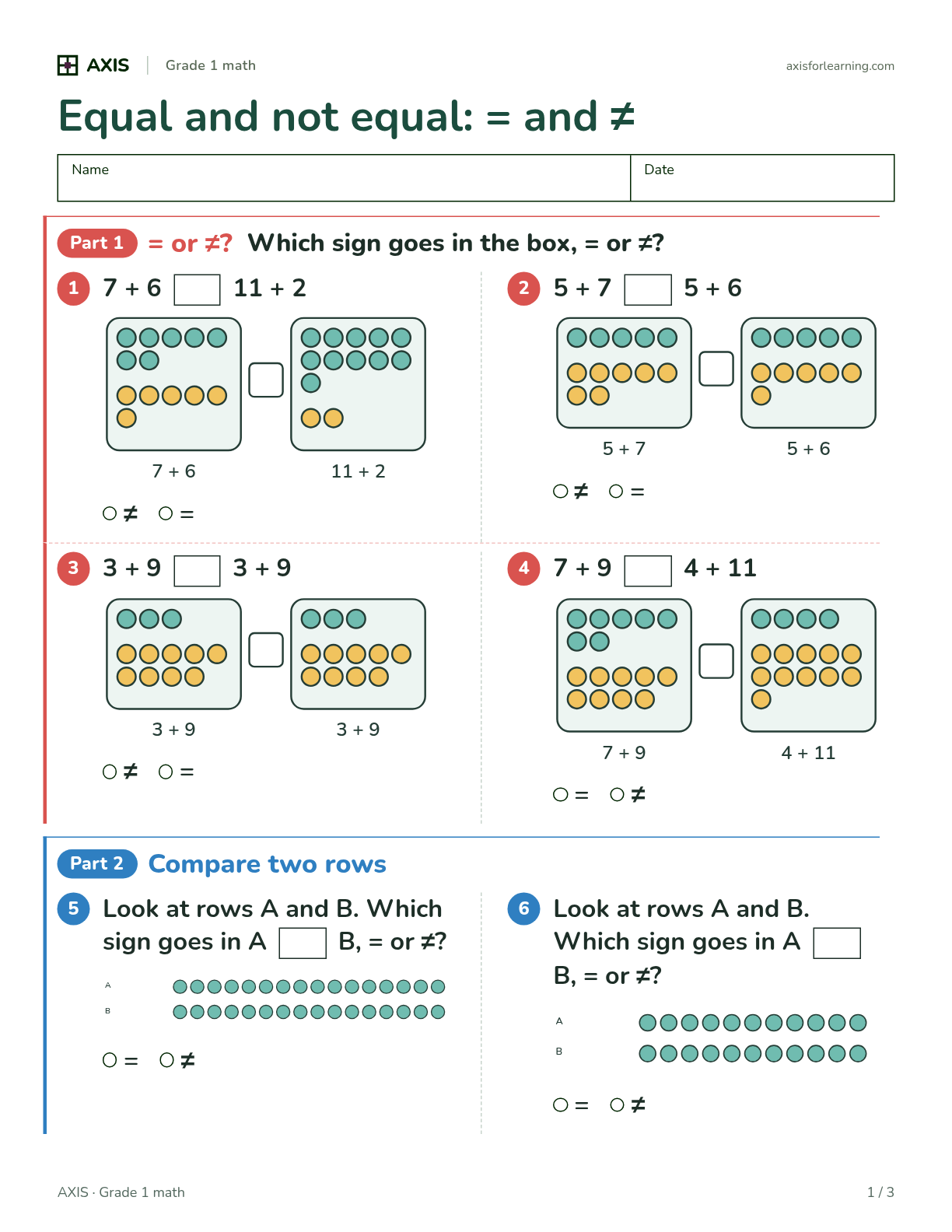
An Alberta Grade 1 worksheet on equality with 16 questions in six parts, all within 20. Children choose = or ≠ between two additions with the dots for each number drawn on each side, compare two rows of dots, and decide whether equations such as 13 = 7 + 4 are true or false. They find the number that makes both sides equal, choose the sign for a balance with cubes on each side, and find how many cubes level a balance. It prints as three student pages and a two-page answer key.
What's inside this worksheet
- Part 1
= or ≠?
Questions 1–4. Two additions with their dots drawn on each side and a box between. Children choose = or ≠.
- Part 2
Compare two rows
Questions 5–6. Two rows of dots, A and B. Children choose the sign for A ▢ B.
- Part 3
True or false?
Questions 7–10. An equation such as 8 = 2 + 5 or 6 + 8 = 8 + 6, with the dots for each side. Children circle True or False.
- Part 4
Make it true
Questions 11–12. An equation such as 8 + 3 = ▢ + 2. Children circle the number that makes both sides equal.
- Part 5
Balance
Questions 13–14. Cubes on each side of a balance. Children choose = if the sides are the same and ≠ if they are not.
- Part 6
Balance stories
Questions 15–16. A level balance with cubes on one side and some cubes missing on the other. Children write how many more cubes are there.
Curriculum objectives covered
Alberta Kindergarten to Grade 6 Mathematics (2022)
The outcome in short: Explore quantities up to 100: count on from any number, count back from 20, skip count, show amounts in different ways, share and group, and compare amounts with = and ≠. Official wording ↗
On this sheet: Children compare two amounts with = and ≠ (Parts 1, 2 and 5).
The outcome in short: Explore addition and subtraction within 20 through stories, strategies and a balance, find missing numbers, check with the opposite operation, and learn facts to 10 + 10. Official wording ↗
On this sheet: Children read the equal sign as both sides being the same amount: true or false equations written either way round (Part 3), the number that makes both sides equal (Part 4) and a level balance (Part 6).
Teaching with the Common Core? The US version of this worksheet follows the Common Core State Standards, with the other US Kindergarten math worksheets.
How teachers use it
- Same, not answer
- Before Part 3, ask what the equal sign means. Children who say the answer comes next will find 13 = 7 + 4 strange, which is the point to talk about.
- Use a real balance
- For Parts 5 and 6, a pan balance and cubes let children test their answer. Alberta's outcome works with a balance as a model.
- Write your own
- Ask children to write one true and one false equation for a partner. Writing false ones shows they know what makes an equation true.
Questions teachers ask
- How many problems are on this worksheet?
- 16 questions in 6 parts on 3 pages, with a 2-page answer key at the end.
- What grade and standard is it for?
- Grade 1. Alberta: Number 1, Number 2.
- Can I print more than one version?
- Yes. There are 6 ready-made versions, each with different numbers and its own answer key, and the same version always prints the same. For more, generate a new worksheet in the generator.
- What does ≠ mean?
- It means not equal: the two sides are different amounts. Alberta's Grade 1 outcome uses both = and ≠ to compare.
- Are the equations all additions?
- Parts 1, 3 and 4 use additions within 20, written either way round; the balance questions use cubes. Every amount is 20 or less.
Need a different skill?
Make your own worksheet for any K–8 skill in seconds, with its answer key.