2D shapes and 3D solids
This Grade 1 worksheet practises naming circles, triangles, squares and rectangles and the common solids in any size or position, and telling prisms from pyramids (Alberta Geometry 1).
- Grade 1
- Geometry
- 2 pages + 1-page answer key
- Alberta curriculum (2022)
- 6 free versions
Every PDF includes the answer key
12 questions on 2 pages, plus a 1-page answer key · each version has different numbers · Print from the browser
Need a different skill or more questions?
Make a new worksheet in seconds, with its answer key.
About this worksheet
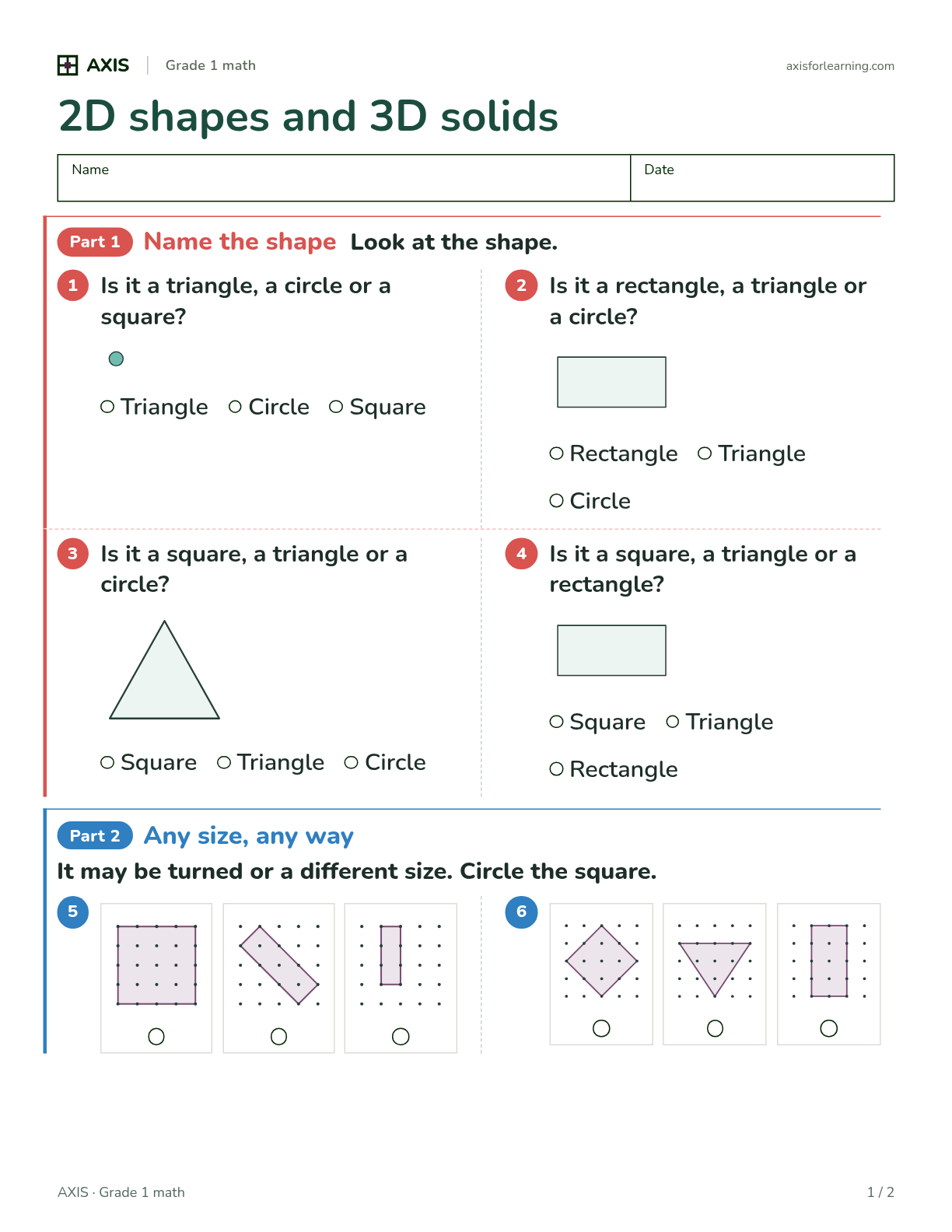
An Alberta Grade 1 geometry worksheet with 12 questions in five parts. Children name a circle, triangle, square or rectangle, then find a named shape among others that are bigger, smaller or turned. They name a cube, cone, cylinder or sphere, pick the one solid that is different from two others drawn in different sizes and positions, and circle a prism, a pyramid or the solid that is neither. Every question is a picture to look at. It prints as two student pages and a one-page answer key.
What's inside this worksheet
- Part 1
Name the shape
Questions 1–4. A circle, triangle, square or rectangle. Children circle its name.
- Part 2
Any size, any way
Questions 5–6. Three shapes on dot paper, in different sizes and turned different ways. Children circle the one that is the named shape.
- Part 3
Name the solid
Questions 7–8. A cube, cone, cylinder or sphere. Children circle its name.
- Part 4
The different solid
Questions 9–10. Three solids, two of them the same solid in a different size or position. Children circle the one that is different.
- Part 5
Prisms and pyramids
Questions 11–12. Three solids. Children circle the prism, the pyramid or the solid that is neither.
Curriculum objectives covered
Alberta Kindergarten to Grade 6 Mathematics (2022)
The outcome in short: Explore flat shapes and solids in different sizes and positions, sort them by one feature, put them together and take them apart, and find lines of symmetry by folding. Official wording ↗
On this sheet: Children name flat shapes (Part 1) and recognize them in different sizes and positions (Part 2), name solids (Part 3) whatever their size or position (Part 4), and tell prisms from pyramids (Part 5).
Teaching with the Common Core? The US version of this worksheet follows the Common Core State Standards, with the other US Kindergarten math worksheets.
How teachers use it
- Turn it over
- Before Part 2, hold up a paper square and turn it so it stands on a corner. Children who call it a diamond are the ones to watch in this part.
- Bring in the solids
- For Parts 3 to 5, put real solids on the table: a can, a ball, a box and a party hat. Children can hold the one in the picture.
- Faces that meet
- In Part 5, ask children to point to where the faces of a pyramid meet. A prism has two matching ends instead.
Questions teachers ask
- How many problems are on this worksheet?
- 12 questions in 5 parts on 2 pages, with a 1-page answer key at the end.
- What grade and standard is it for?
- Grade 1. Alberta: Geometry 1.
- Can I print more than one version?
- Yes. There are 6 ready-made versions, each with different numbers and its own answer key, and the same version always prints the same. For more, generate a new worksheet in the generator.
- Which shapes and solids are on it?
- Circles, triangles, squares and rectangles; cubes, cones, cylinders and spheres; and prisms and pyramids, the shapes and solids of Alberta's Grade 1 outcome.
- Is there a Common Core version?
- The US page Shapes and attributes is about the sides and corners that make a shape, as in the Common Core for Grade 1.
Need a different skill?
Make your own worksheet for any K–8 skill in seconds, with its answer key.