Counting activities: aloud and at a glance
This Grade 1 activity guide practises counting on aloud, counting back from 20, counting by tens, twos and fives, seeing an amount at a glance and showing a number in four ways, one child at a time (Alberta Number 1).
- Grade 1
- Number
- 2-page guide + class record
- Alberta curriculum (2022)
- 6 free versions
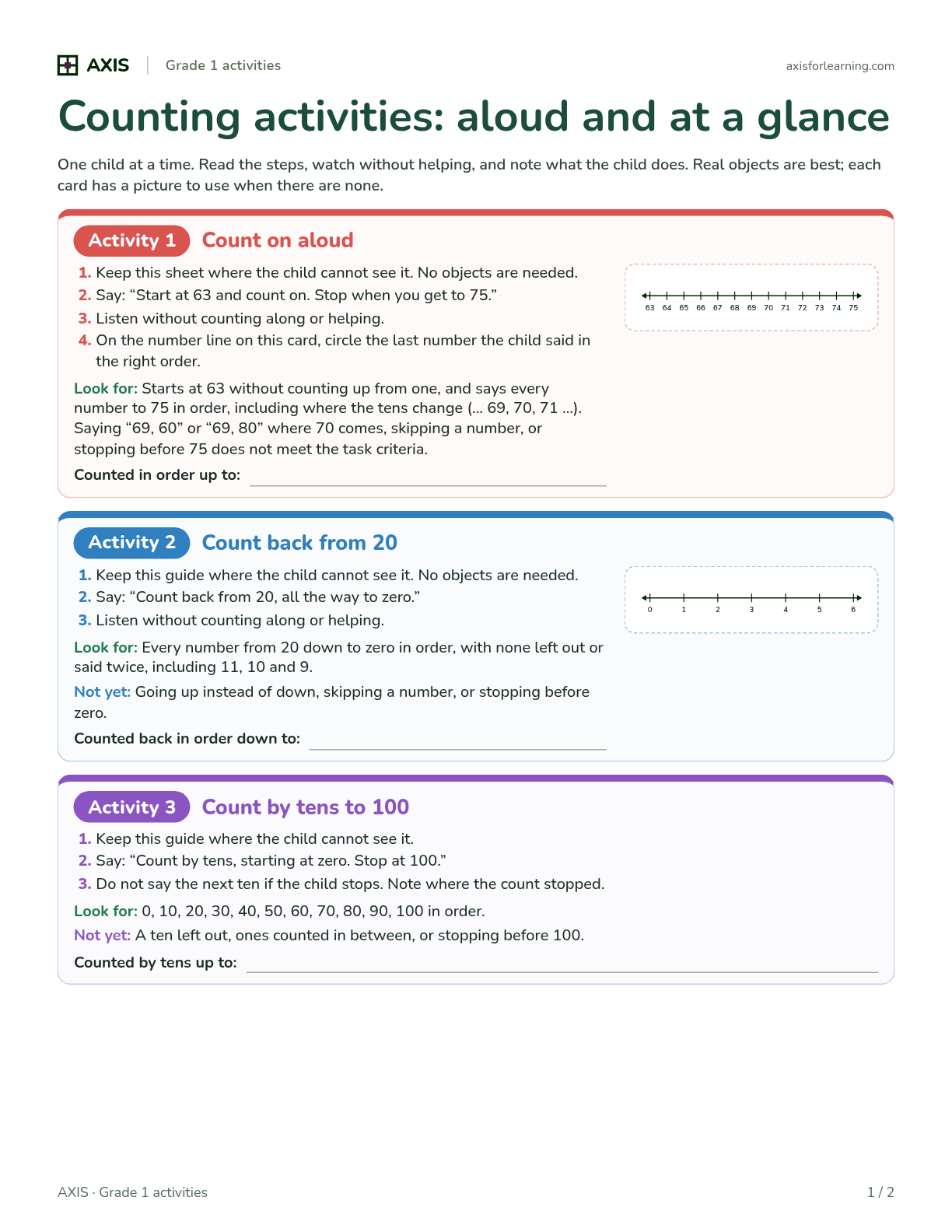
Every activity says what to look for
6 activities on 2 pages, plus a class record sheet · each version has different numbers · Print from the browser
About this guide
A teacher's guide to six one-on-one Alberta Grade 1 counting activities. The child counts on aloud from a number across a change of ten, counts back from 20 to zero, counts by tens to 100 and by twos and fives, says how many dots a card shows after a two-second look, and shows a number with counters, a drawing, its name and its numeral. Each activity is on its own coloured card with the steps, what to look for and what counts as Not yet, beside a picture where the child needs one. A class record sheet comes last.
What's inside this guide
- Activity 1
Count on aloud
The child starts at a number between 1 and 100 and counts on aloud to a stopping number, across a change of ten.
- Activity 2
Count back from 20
The child counts back aloud from 20 to zero.
- Activity 3
Count by tens to 100
The child counts by tens from zero to 100.
- Activity 4
Count by twos and fives
The child counts by twos to 20 and by fives to 100, on the same day or two different days.
- Activity 5
How many at a glance?
You show a dot card for about two seconds; the child says how many without counting each dot.
- Activity 6
Show a number four ways
The child makes a number with counters, draws it, says it and finds its numeral.
Curriculum objectives covered
Alberta Kindergarten to Grade 6 Mathematics (2022)
The outcome in short: Explore quantities up to 100: count on from any number, count back from 20, skip count, show amounts in different ways, share and group, and compare amounts with = and ≠. Official wording ↗
On this sheet: Every activity watches a part of counting that a written answer cannot show: counting on across a ten (Activity 1), counting back from 20 (Activity 2), counting by tens, twos and fives (Activities 3 and 4), recognizing an amount at a glance (Activity 5) and representing a number four ways (Activity 6).
How teachers use it
- A few children a day
- Take two or three children aside while the class works, and do one or two activities with each. In two weeks every child has done all six.
- Mark the class record
- Tick what a child did on their own, mark Not yet, and write the date. A child marked Not yet can try the same activity again with different numbers from another version.
- Real objects first
- Counters, cubes, blocks and objects from the classroom work best. Cards with a picture can be cut out and used when there are none to hand.
Questions teachers ask
- How many activities are in this guide?
- 6 activities on 2 pages, with a class record sheet at the end.
- What grade and standard is it for?
- Grade 1. Alberta: Number 1.
- Can I print more than one version?
- Yes. There are 6 ready-made versions, each with different numbers and objects, and the same version always prints the same. A child marked Not yet can try an activity again from another version.
- Why are these done aloud, one on one?
- Counting on, back and by tens is heard, not written. Listening to one child shows where a count goes wrong, such as 99, 90 instead of 100.
- Is there a counting worksheet to go with them?
- Yes. Counting to 100, and Count, show and share groups, practise the same outcome on paper.
Need a different skill?
Make your own worksheet for any K–8 skill in seconds, with its answer key.