Shape activities: name, sort, build and fold
This Grade 1 activity guide practises naming flat shapes and solids, sorting shapes by one feature, putting shapes together to make a larger shape, building a model from a picture and finding matching halves by folding, one child at a time (Alberta Geometry 1).
- Grade 1
- Geometry
- 2-page guide + class record
- Alberta curriculum (2022)
- 6 free versions
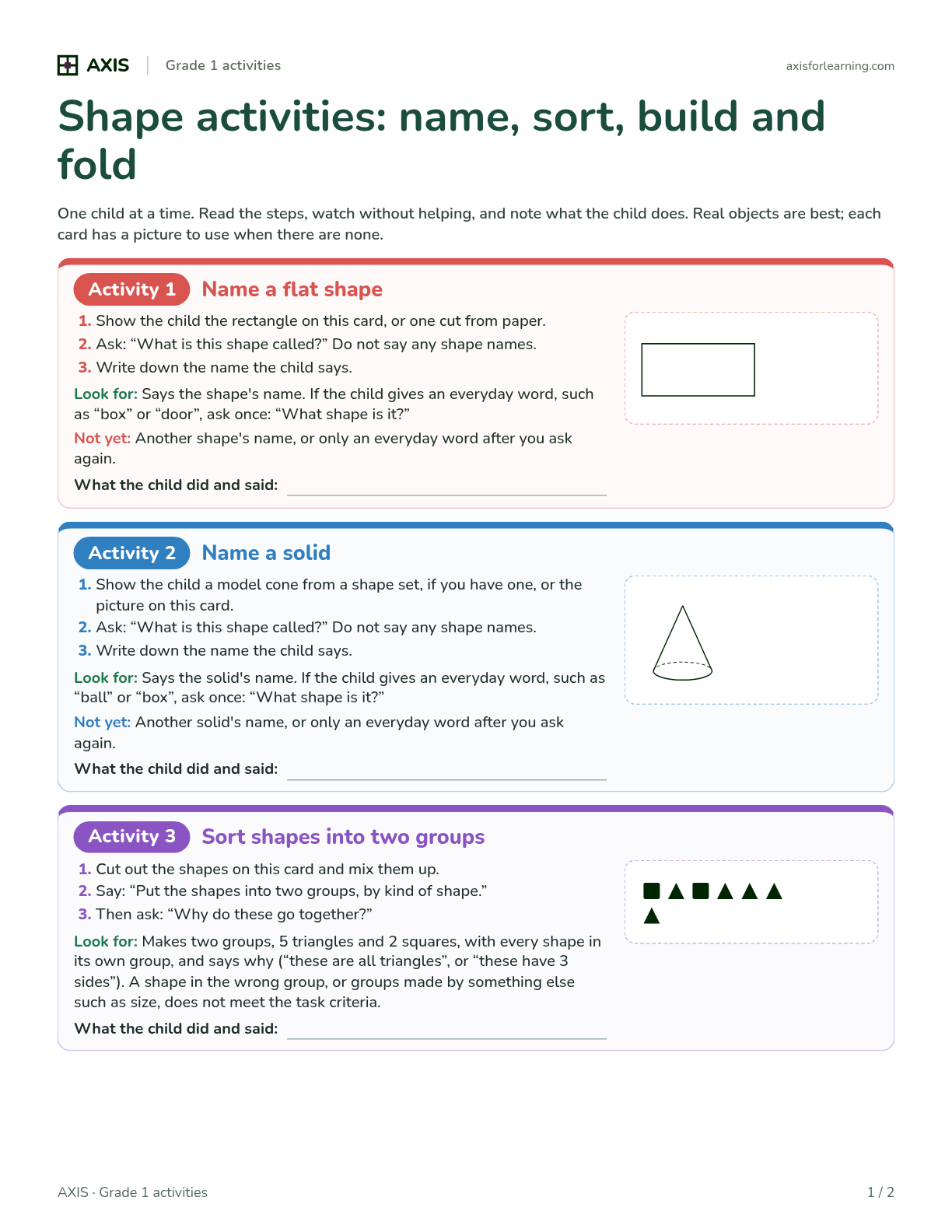
Every activity says what to look for
6 activities on 2 pages, plus a class record sheet · each version has different numbers · Print from the browser
About this guide
A teacher's guide to six one-on-one Alberta Grade 1 shape activities. The child names a flat shape and a solid without being given the names, sorts cut-out shapes into two groups and says why, puts two cut-out pieces together to make a rectangle with no gaps or overlaps and names the pieces, builds the same block model as a picture, and folds a paper rectangle so its two parts match. Each activity is on its own coloured card with the steps, what to look for and what counts as Not yet, beside the picture or pieces to cut out. A class record sheet comes last.
What's inside this guide
- Activity 1
Name a flat shape
You show a shape; the child names it without hearing any shape names.
- Activity 2
Name a solid
You show a solid or its picture; the child names it.
- Activity 3
Sort shapes into two groups
The child sorts cut-out shapes by kind of shape and says why each group goes together.
- Activity 4
Make a rectangle from pieces
The child puts two cut-out pieces together to make a rectangle and names the pieces.
- Activity 5
Copy a block model
The child builds the same block shape as the picture.
- Activity 6
Fold to match
The child folds a paper rectangle so its two parts match and says how they know.
Curriculum objectives covered
Alberta Kindergarten to Grade 6 Mathematics (2022)
The outcome in short: Explore flat shapes and solids in different sizes and positions, sort them by one feature, put them together and take them apart, and find lines of symmetry by folding. Official wording ↗
On this sheet: Naming flat shapes and solids (Activities 1 and 2), sorting shapes by one feature (Activity 3), putting shapes together into a larger shape (Activity 4), building a model of a solid from a picture (Activity 5) and finding matching halves by folding (Activity 6).
How teachers use it
- A few children a day
- Take two or three children aside while the class works, and do one or two activities with each. In two weeks every child has done all six.
- Mark the class record
- Tick what a child did on their own, mark Not yet, and write the date. A child marked Not yet can try the same activity again with different numbers from another version.
- Real objects first
- Counters, cubes, blocks and objects from the classroom work best. Cards with a picture can be cut out and used when there are none to hand.
Questions teachers ask
- How many activities are in this guide?
- 6 activities on 2 pages, with a class record sheet at the end.
- What grade and standard is it for?
- Grade 1. Alberta: Geometry 1.
- Can I print more than one version?
- Yes. There are 6 ready-made versions, each with different numbers and objects, and the same version always prints the same. A child marked Not yet can try an activity again from another version.
- What do I need?
- Scissors to cut out the pieces beforehand, a few same-size blocks and, if you have them, a shape set with a cube and a sticky note.
- Is there a worksheet to go with them?
- Yes. 2D shapes and 3D solids, and Sort, cut and fold shapes, practise the same outcome on paper.
Need a different skill?
Make your own worksheet for any K–8 skill in seconds, with its answer key.