Shapes in nature
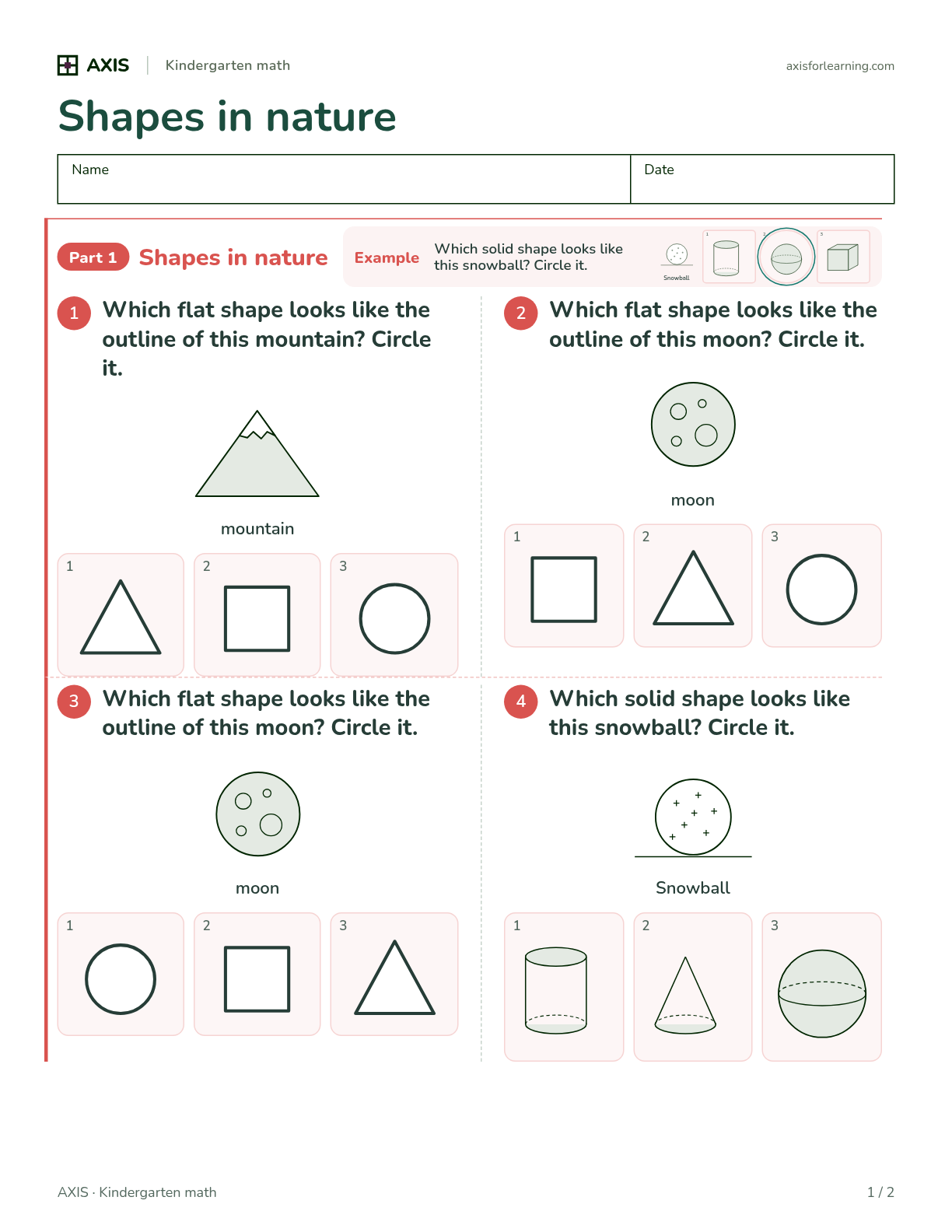
This Kindergarten worksheet practises finding shapes in nature and everyday objects, recognizing curved parts and predicting which solids roll (Alberta Geometry 1).
- Kindergarten
- Geometry
- 2 pages + 1-page answer key
- Alberta curriculum (2022)
- 6 free versions
Every PDF includes the answer key
10 questions on 2 pages, plus a 1-page answer key · each version has different numbers · Print from the browser
Need a different skill or more questions?
Make a new worksheet in seconds, with its answer key.
About this worksheet
An Alberta Kindergarten shapes worksheet with 10 picture questions in four parts. Children circle the flat shape that a natural object's outline looks like, such as a mountain or the moon, or the solid that something in nature looks like, such as a log or an icicle. They match everyday objects, like a plate or a ball, to a shape or solid, circle the shape with a curved part, and circle the solid that could roll. It prints as two student pages and a one-page answer key.
What's inside this worksheet
- Part 1
Shapes in nature
Questions 1–4. A picture from nature, such as a mountain, the moon, a pine cone or an icicle. Children circle the flat shape its outline looks like, or the solid it looks like.
- Part 2
Around us
Questions 5–6. An everyday object, such as a plate, a door, a ball or an ice cream cone. Children circle the flat shape or solid it looks like.
- Part 3
Curved parts
Questions 7–8. Three shapes. Children circle the one with a curved part.
- Part 4
Which can roll?
Questions 9–10. Three solids. Children circle the one that could roll.
Curriculum objectives covered
Alberta Kindergarten to Grade 6 Mathematics (2022)
The outcome in short: Explore familiar two- and three-dimensional shapes, their features, where they appear in nature, and how three-dimensional shapes roll, slide or stack. Official wording ↗
On this sheet: Parts 1 and 2 find familiar shapes in nature and in everyday objects, Part 3 looks at a feature (a curved part), and Part 4 predicts which solid rolls. Rolling, stacking and sliding real solids is a separate hands-on activity.
How teachers use it
- Nature walk
- Take the class outside before the sheet and look for circles, triangles and cylinders: a tree trunk, a pine cone, a round stone.
- Roll it
- After Part 4, test the answers with real solids on a ramp. Children see that a curved surface rolls and a flat face slides or stacks.
- Draw your own
- Ask children to draw something from nature on the back and say which shape it looks like.
Questions teachers ask
- How many problems are on this worksheet?
- 10 questions in 4 parts on 2 pages, with a 1-page answer key at the end.
- What grade and standard is it for?
- Kindergarten. Alberta: Geometry 1.
- Can I print more than one version?
- Yes. There are 6 ready-made versions, each with different numbers and its own answer key, and the same version always prints the same. For more, generate a new worksheet in the generator.
- Does it include First Nations, Métis and Inuit examples?
- Not on this sheet. The Alberta Kindergarten activities include a hands-on lesson on shapes in Indigenous art.
- Do children need to roll real solids?
- Not for the sheet: Part 4 asks for a prediction from the picture. Rolling, stacking and sliding real solids is worth doing as a class activity afterwards.
Need a different skill?
Make your own worksheet for any K–8 skill in seconds, with its answer key.