Count forward and back to 10
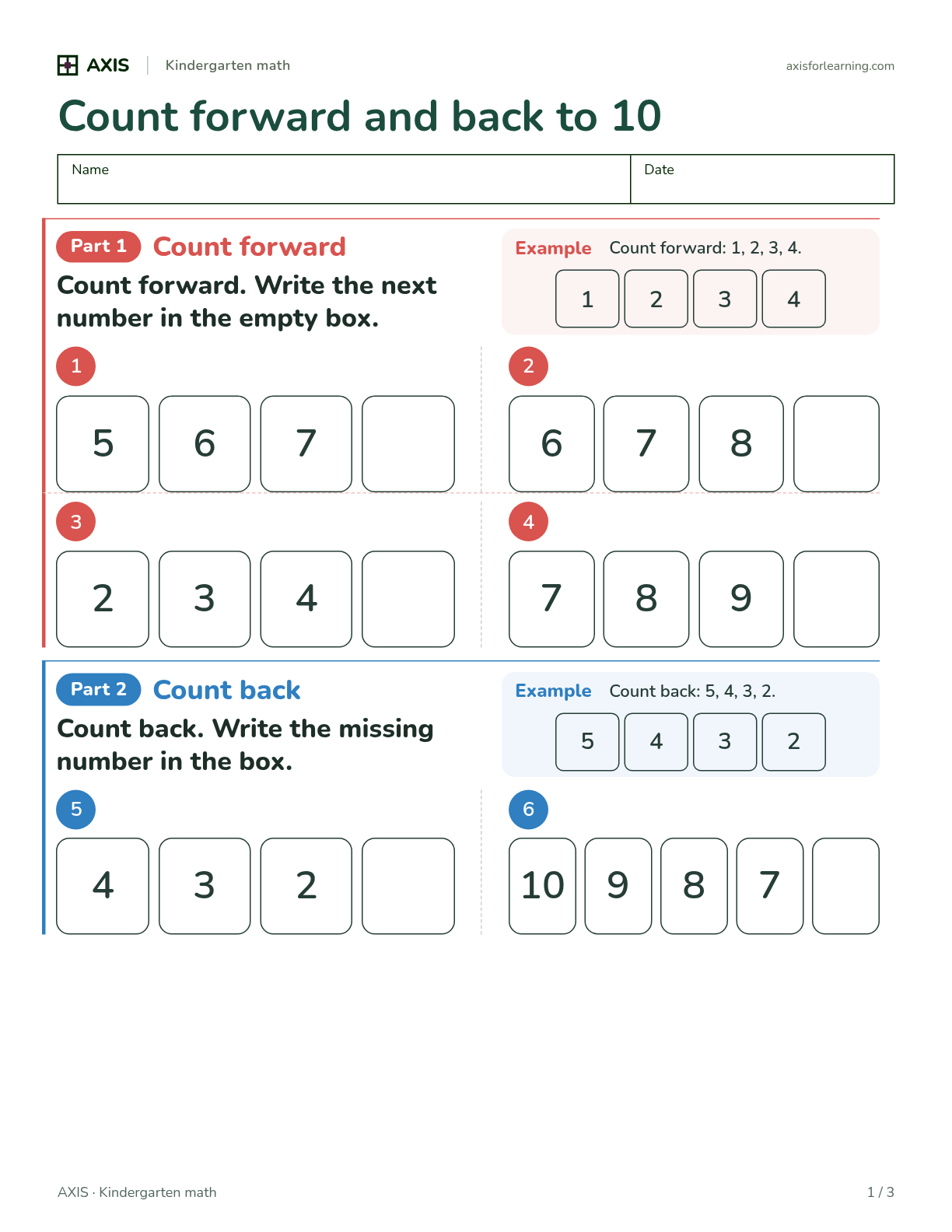
This Kindergarten worksheet practises counting forward and back within 10, counting a row from either end and counting a mixed group (Alberta Number 1).
- Kindergarten
- Number
- 3 pages + 1-page answer key
- Alberta curriculum (2022)
- 6 free versions
Every PDF includes the answer key
14 questions on 3 pages, plus a 1-page answer key · each version has different numbers · Print from the browser
Need a different skill or more questions?
Make a new worksheet in seconds, with its answer key.
About this worksheet
An Alberta Kindergarten counting worksheet with 14 questions in four parts, all within 10. Children write the next number in a row counting forward, write the missing number counting back towards 0, count a row of pictures from the left and then from the right, and count a group of different objects together. Counting from both ends shows children that the total stays the same however they start. It prints as three student pages and a one-page answer key.
What's inside this worksheet
- Part 1
Count forward
Questions 1–4. Three numbers counting forward, starting anywhere from 1 to 7. Children write the next number, up to 10.
- Part 2
Count back
Questions 5–8. Numbers counting back from 10 or less, with one missing. Children write the missing number.
- Part 3
Count from each end
Questions 9–10. A row of 4 to 9 pictures. Children count from the left and write how many, then count from the right and write how many again.
- Part 4
Count them all
Questions 11–14. A group of different objects, up to 10 in all. Children count every object and write the total.
Curriculum objectives covered
Alberta Kindergarten to Grade 6 Mathematics (2022)
The outcome in short: Explore quantities up to 10. Official wording ↗
On this sheet: Parts 1 and 2 ask for the counting sequence forward to 10 and back towards 0, Part 3 counts the same row from both ends, and Part 4 counts a group of mixed objects. Saying the numbers aloud needs its own observation.
How teachers use it
- Count back as a class
- Count back from 10 together before Part 2, with a rocket blast-off at 0. Children who stumble at 6 or 7 need more counting back aloud before the written version.
- The same number both ways
- After Part 3, ask why the two numbers match. A child who says nothing was added or taken away has understood that the count does not depend on the order.
- Mixed objects in the classroom
- Put a handful of blocks, crayons and erasers on a table and count them all together, as in Part 4. Children see that different things still count as one each.
Questions teachers ask
- How many problems are on this worksheet?
- 14 questions in 4 parts on 3 pages, with a 1-page answer key at the end.
- What grade and standard is it for?
- Kindergarten. Alberta: Number 1.
- Can I print more than one version?
- Yes. There are 6 ready-made versions, each with different numbers and its own answer key, and the same version always prints the same. For more, generate a new worksheet in the generator.
- Does it count back to 0?
- Yes, sometimes. The rows count back from 10 or less, and the missing number can be anything from 0 to 8.
- Can children do it without reading?
- Mostly. The numbers and pictures carry each question; read the short direction aloud once per part.
Need a different skill?
Make your own worksheet for any K–8 skill in seconds, with its answer key.