Measurement activities: compare and fit
This Kindergarten activity guide practises naming what can be measured about an object, comparing two objects directly and choosing a lid that is the right size, one child at a time (Alberta Measurement 1).
- Kindergarten
- Measurement
- 1-page guide + class record
- Alberta curriculum (2022)
- 6 free versions
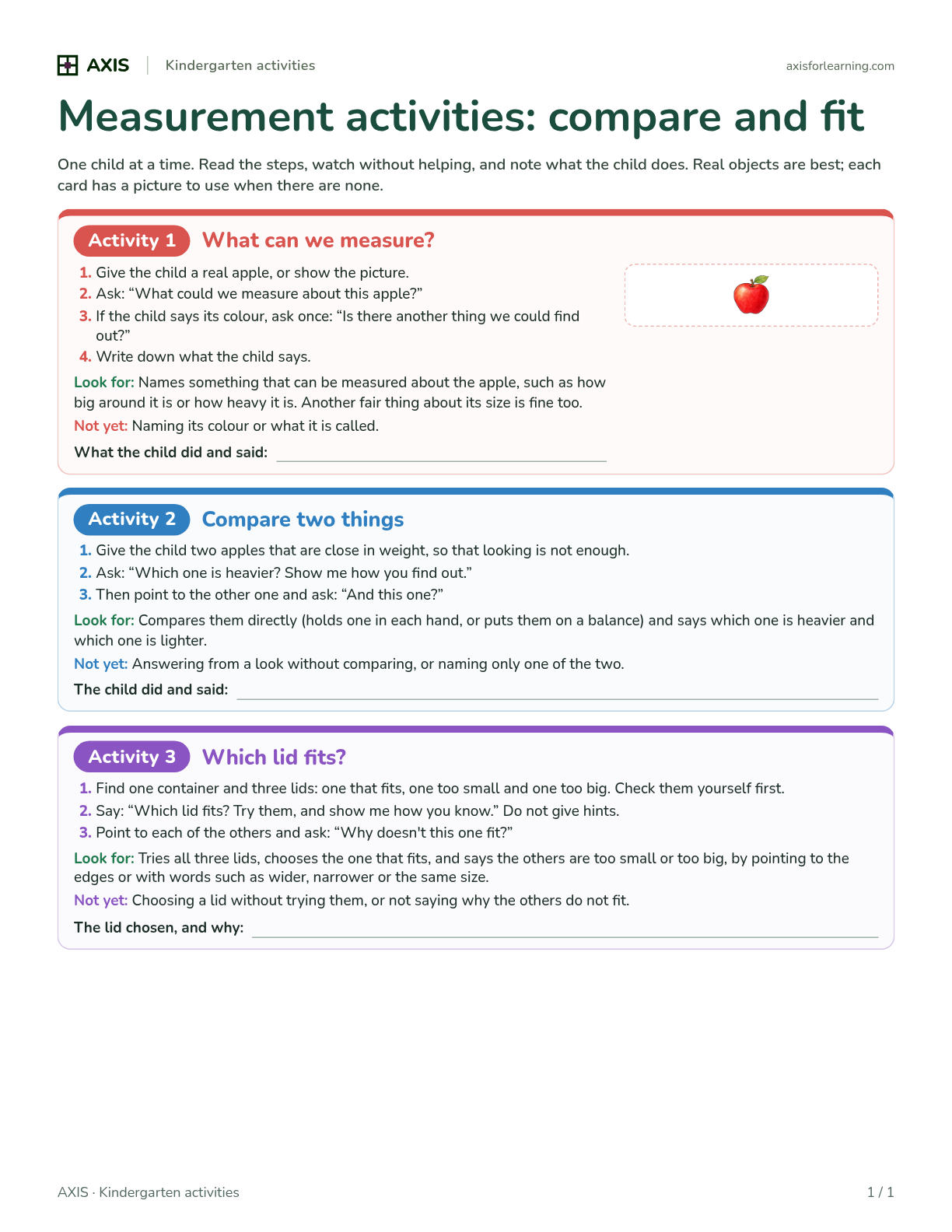
Every activity says what to look for
3 activities on 1 page, plus a class record sheet · each version has different numbers · Print from the browser
About this guide
A teacher's guide to three one-on-one Alberta Kindergarten measurement activities with real objects. The child says something about an everyday object that can be measured, compares two objects that are close in size directly, by lining them up or holding one in each hand, and says which is longer, heavier or holds more, and tries three lids on a container to find the one that fits and says why the others do not. Each activity is on its own coloured card with the steps, what to look for and what counts as Not yet. A class record sheet comes last.
What's inside this guide
- Activity 1
What can we measure?
The child names something about an everyday object that could be measured, such as how heavy it is or how much it holds.
- Activity 2
Compare two things
The child compares two objects that are close in size directly, such as two straws by length or two apples by weight, and says which is which.
- Activity 3
Which lid fits?
The child tries three lids on a container and says why the one that fits is the right size.
Curriculum objectives covered
Alberta Kindergarten to Grade 6 Mathematics (2022)
The outcome in short: Explore size by comparing objects directly and deciding what size works for different needs. Official wording ↗
On this sheet: Naming a measurable attribute (Activity 1), comparing two objects directly by one attribute (Activity 2), and deciding whether something is the right size for a job (Activity 3).
How teachers use it
- A few children a day
- Take two or three children aside while the class works, and do one or two activities with each. In two weeks every child has done all three.
- Mark the class record
- Tick what a child did on their own, mark Not yet, and write the date. A child marked Not yet can try the same activity again with different numbers from another version.
- Real objects first
- Counters, blocks and objects from the classroom work best. Each card has a picture to use when there are none to hand, and the picture can be cut out.
Questions teachers ask
- How many activities are in this guide?
- 3 activities on 1 page, with a class record sheet at the end.
- What grade and standard is it for?
- Kindergarten. Alberta: Measurement 1.
- Can I print more than one version?
- Yes. There are 6 ready-made versions, each with different numbers and objects, and the same version always prints the same. A child marked Not yet can try an activity again from another version.
- What do I need?
- The everyday objects each card names, and a container with three lids of different sizes. The first card has a picture to use when the object is not to hand.
- Is there a worksheet to go with them?
- Yes. Compare sizes practises comparing on paper.
Need a different skill?
Make your own worksheet for any K–8 skill in seconds, with its answer key.