More, fewer or the same
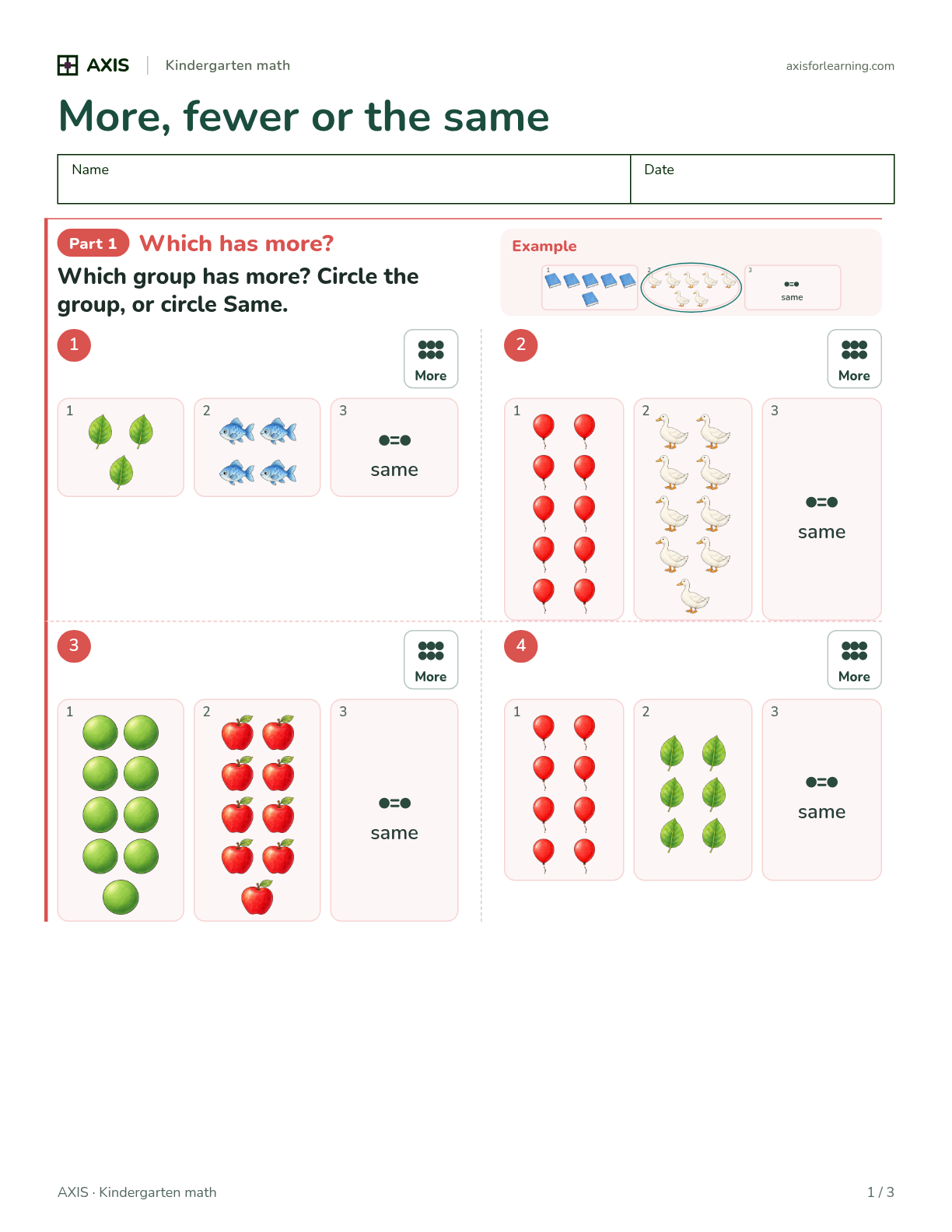
This Kindergarten worksheet practises comparing two groups of up to 10 objects: more, fewer or the same (Alberta Number 1).
- Kindergarten
- Number
- 3 pages + 1-page answer key
- Alberta curriculum (2022)
- 6 free versions
Every PDF includes the answer key
8 questions on 3 pages, plus a 1-page answer key · each version has different numbers · Print from the browser
Need a different skill or more questions?
Make a new worksheet in seconds, with its answer key.
About this worksheet
An Alberta Kindergarten worksheet on comparing amounts, with 8 picture questions in four parts. Children circle the group with more or circle Same, draw lines to pair the objects in two rows and circle the row with more or fewer, find the group with the same number as a model, and decide whether a row of dots has more, fewer or the same number after it is spread out. Pairing and spreading out help children compare without being fooled by how long a row looks. It prints as three student pages and a one-page answer key.
What's inside this worksheet
- Part 1
Which has more?
Questions 1–4. Two groups of up to 10 pictures. Children circle the group with more, or circle Same when they are equal.
- Part 2
Pair them up
Questions 5–6. Two rows of objects. Children draw lines to pair one from each row, then circle the row with more or fewer, as asked, or Same.
- Part 3
Find the same number
Question 7. A model group sits above three others. Children count the model and circle the group with the same number.
- Part 4
Spread out
Question 8. A group of dots before, and a row of dots after it is spread out. Children count both and circle More, Fewer or Same.
Curriculum objectives covered
Alberta Kindergarten to Grade 6 Mathematics (2022)
The outcome in short: Explore quantities up to 10. Official wording ↗
On this sheet: Every part compares amounts: by counting or matching (Parts 1 and 2), by finding an equal group (Part 3), and by comparing a group before and after it is spread out (Part 4).
Teaching with the Common Core? The US version of this worksheet follows the Common Core State Standards, with the other US Kindergarten math worksheets.
How teachers use it
- Pairing beats counting
- In Part 2, encourage children to draw the lines before counting. Pairing one to one is how young children compare reliably, and it works for any size of group.
- The spread-out trick
- Do Part 4 with real counters first: line up 6, then spread them out and ask if there are more now. Children who say more are still judging by length.
- Quick warm-up
- Show two handfuls of blocks and ask which has fewer. The word fewer is harder than more, so practise it out loud.
Questions teachers ask
- How many problems are on this worksheet?
- 8 questions in 4 parts on 3 pages, with a 1-page answer key at the end.
- What grade and standard is it for?
- Kindergarten. Alberta: Number 1.
- Can I print more than one version?
- Yes. There are 6 ready-made versions, each with different numbers and its own answer key, and the same version always prints the same. For more, generate a new worksheet in the generator.
- Does it use the word fewer?
- Yes. Part 2 asks for the row with more or the row with fewer, and Part 4 offers More, Fewer or Same, alongside more in Part 1.
- Is there a Common Core version?
- The closest US page is Comparing numbers to 10, which also compares written numbers.
Need a different skill?
Make your own worksheet for any K–8 skill in seconds, with its answer key.