Tens and ones
This Grade 1 worksheet practices reading two-digit numbers as tens and ones with base-ten blocks and a place value chart (Common Core 1.NBT.B.2, 1.NBT.B.2b, 1.NBT.B.2c).
- Grade 1
- Number and operations in base ten
- 2 pages + 1-page answer key
- Common Core aligned
- 6 free versions
Every PDF includes the answer key
10 questions on 2 pages, plus a 1-page answer key · each version has different numbers · Print from the browser
Need a different skill or more questions?
Make a new worksheet in seconds, with its answer key.
About this worksheet
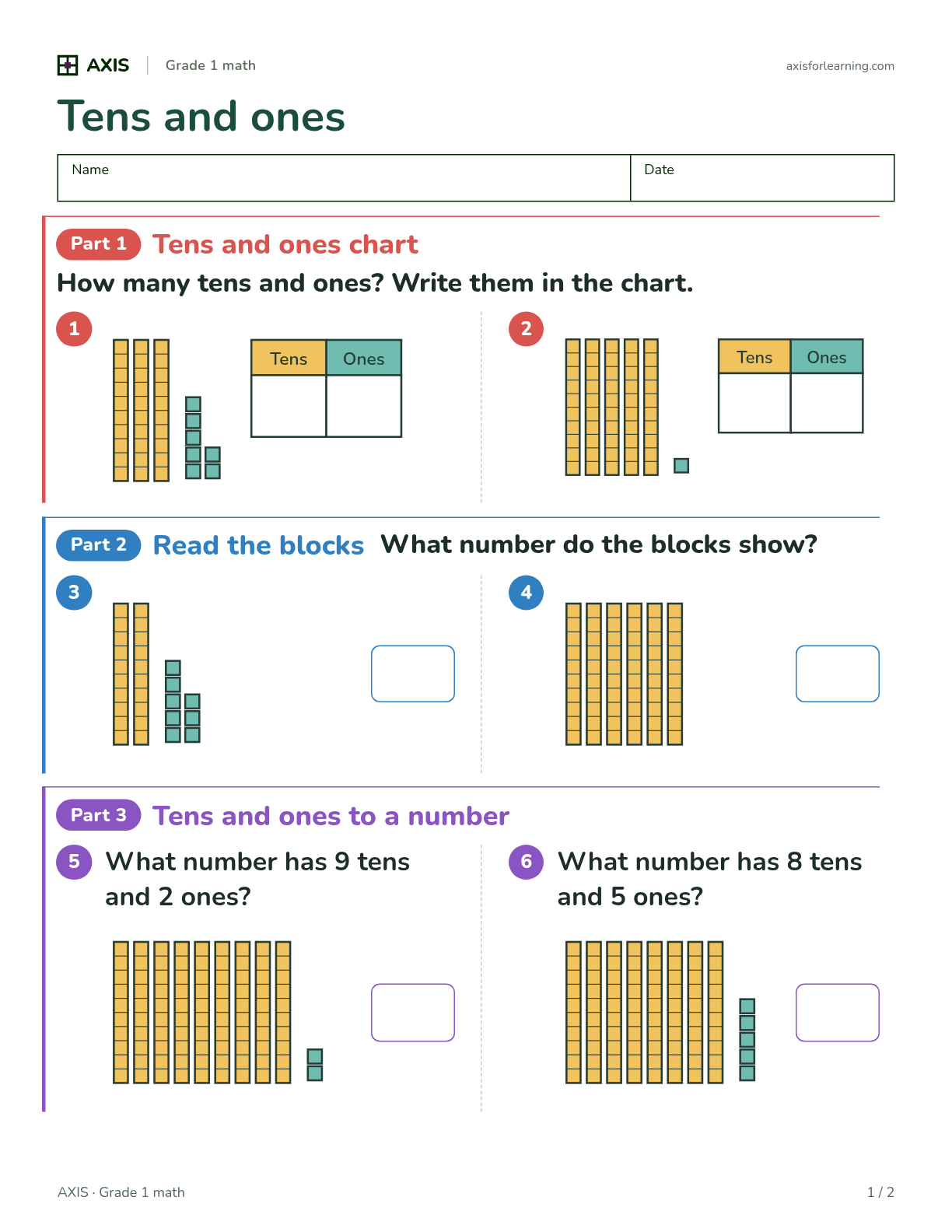
A Grade 1 tens and ones worksheet with 10 questions in five parts. Children count base-ten rods and cubes and write the tens and ones in a chart, write the number a set of blocks shows, write the number for a given number of tens and ones, read a teen number as one ten and some ones, and say how many tens a number such as 70 is. Every question shows the blocks, and every version has new numbers and its own answer key.
What's inside this worksheet
- Part 1
Tens and ones chart
Questions 1–2. Base-ten rods and cubes for a number from 11 to 99. Children write the tens and the ones in the chart.
- Part 2
Read the blocks
Questions 3–4. Rods and cubes. Children write the number they show.
- Part 3
Tens and ones to a number
Questions 5–6. A number of tens and ones, such as 4 tens and 7 ones, with its blocks. Children write the number.
- Part 4
Teen numbers
Questions 7–8. A teen number in words with one rod and some cubes. Children write how many ones.
- Part 5
Count the tens
Questions 9–10. A multiple of ten shown as rods. Children write how many tens.
Curriculum objectives covered
Common Core State Standards for Mathematics
- 1.NBT.B.2Number and operations in base ten
“Understand that the two digits of a two-digit number represent amounts of tens and ones.”
On this sheet: Parts 1 to 3 show two-digit numbers from 10 to 99 as tens rods and ones cubes, and children write the tens digit and the ones digit for each amount.
- 1.NBT.B.2bNumber and operations in base ten
“The numbers from 11 to 19 are composed of a ten and one, two, three, four, five, six, seven, eight, or nine ones.”
On this sheet: Part 4 shows a teen number as one rod and some cubes and asks how many ones it has beyond the ten.
- 1.NBT.B.2cNumber and operations in base ten
“The numbers 10, 20, 30, 40, 50, 60, 70, 80, 90 refer to one, two, three, four, five, six, seven, eight, or nine tens (and 0 ones).”
On this sheet: Part 5 shows a multiple of ten as rods only, such as 60, and asks how many tens it is.
How teachers use it
- Bundle first
- Before the sheet, bundle straws into tens with rubber bands. Children who count every cube on the sheet one by one need more bundling.
- Watch for reversals
- In Part 2, a child who writes 37 for 7 rods and 3 cubes has the digits in the wrong places. Point to the chart: tens on the left.
- Zero ones
- Some questions have 0 ones, such as 5 tens. Ask why the number is 50 and not 5.
Questions teachers ask
- How many problems are on this worksheet?
- 10 questions in 5 parts on 2 pages, with a 1-page answer key at the end.
- What grade and standard is it for?
- Grade 1. Common Core: 1.NBT.B.2, 1.NBT.B.2b, 1.NBT.B.2c.
- Can I print more than one version?
- Yes. There are 6 ready-made versions, each with different numbers and its own answer key, and the same version always prints the same. For more, generate a new worksheet in the generator.
- How high do the numbers go?
- From 10 to 99. Counting past 100 is on the counting to 120 worksheet.
- What are base-ten blocks?
- A rod is ten cubes joined together and a small cube is one. Rods are the tens and cubes are the ones, so a number's blocks show its digits.
Common Core State Standards © Copyright 2010. National Governors Association Center for Best Practices and Council of Chief State School Officers. All rights reserved.
Need a different skill?
Make your own worksheet for any K–8 skill in seconds, with its answer key.