Adding tens and ones within 100
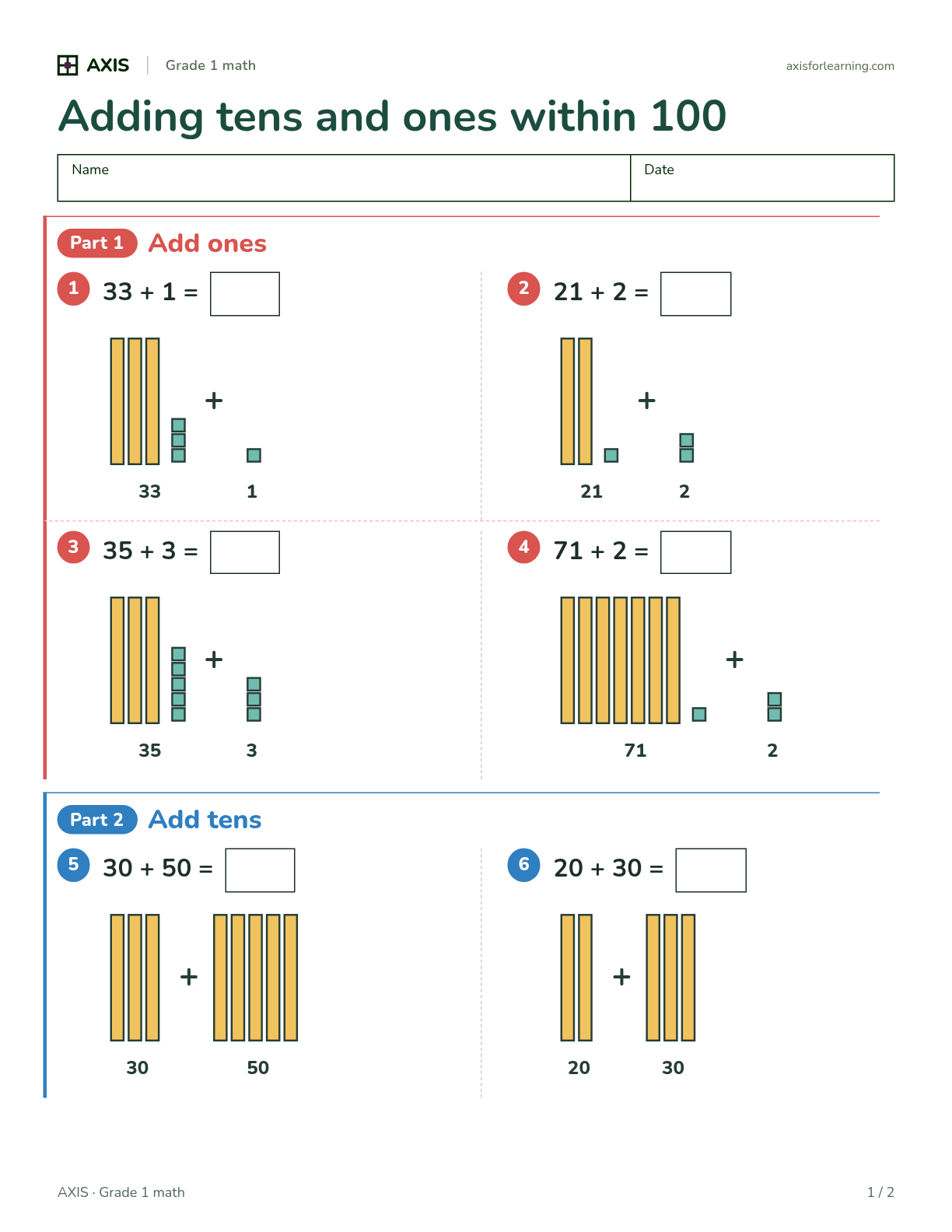
This Grade 1 worksheet practices adding a one-digit number or a multiple of ten to a two-digit number within 100, without regrouping (Common Core 1.NBT.C.4).
- Grade 1
- Number and operations in base ten
- 2 pages + 1-page answer key
- Common Core aligned
- 6 free versions
Every PDF includes the answer key
10 questions on 2 pages, plus a 1-page answer key · each version has different numbers · Print from the browser
Need a different skill or more questions?
Make a new worksheet in seconds, with its answer key.
About this worksheet
A Grade 1 adding within 100 worksheet with 10 questions in four parts. Children add ones to a two-digit number, such as 43 + 5, add tens to tens, such as 30 + 40, and solve short stories that add ones or tens to a two-digit number. Each question shows the numbers as base-ten blocks, so children add ones to ones and tens to tens. No question needs regrouping. Every version has new numbers and its own answer key.
What's inside this worksheet
- Part 1
Add ones
Questions 1–4. A two-digit number and a one-digit number, as rods and cubes. The ones never make a new ten.
- Part 2
Add tens
Questions 5–6. Two multiples of ten, as rods only, such as 20 + 50.
- Part 3
Add ones in a story
Questions 7–8. Children on a bus and a few more getting on.
- Part 4
Add tens in a story
Questions 9–10. Someone has some stickers and gets more in tens.
Curriculum objectives covered
Common Core State Standards for Mathematics
- 1.NBT.C.4Number and operations in base ten
“Add within 100, including adding a two-digit number and a one-digit number, and adding a two-digit number and a multiple of 10, using concrete models or drawings and strategies based on place value, properties of operations, and/or the relationship between addition and subtraction; relate the strategy to a written method and explain the reasoning used.”
On this sheet: Every question adds within 100 with base-ten blocks: a two-digit number and a one-digit number with no new ten (Parts 1 and 3), and a multiple of ten added to a multiple of ten or to a two-digit number (Parts 2 and 4). Composing a ten is not on this sheet.
How teachers use it
- Ones with ones
- In Part 1, ask which digit changes when you add 5 to 43. Children who write 93 have added the 5 to the tens.
- Count by tens
- For Part 2, children can count on by tens from the first number: 30, 40, 50, 60, 70.
- Next step
- Children who finish easily are ready for sums where the ones make a new ten, such as 47 + 6, in Grade 2 work.
Questions teachers ask
- How many problems are on this worksheet?
- 10 questions in 4 parts on 2 pages, with a 1-page answer key at the end.
- What grade and standard is it for?
- Grade 1. Common Core: 1.NBT.C.4.
- Can I print more than one version?
- Yes. There are 6 ready-made versions, each with different numbers and its own answer key, and the same version always prints the same. For more, generate a new worksheet in the generator.
- Does any question need regrouping?
- No. The ones never add up to 10 or more, so no new ten is made.
- How high do the sums go?
- Every sum is 99 or less.
Common Core State Standards © Copyright 2010. National Governors Association Center for Best Practices and Council of Chief State School Officers. All rights reserved.
Need a different skill?
Make your own worksheet for any K–8 skill in seconds, with its answer key.