Addition within 20
This Grade 1 worksheet practices adding within 20 with ten-frames, by making ten, by counting on and by adding three numbers (Common Core 1.OA.C.6, 1.OA.C.5, 1.OA.B.3).
- Grade 1
- Operations and algebraic thinking
- 2 pages + 1-page answer key
- Common Core aligned
- 6 free versions
Every PDF includes the answer key
14 questions on 2 pages, plus a 1-page answer key · each version has different numbers · Print from the browser
Need a different skill or more questions?
Make a new worksheet in seconds, with its answer key.
About this worksheet
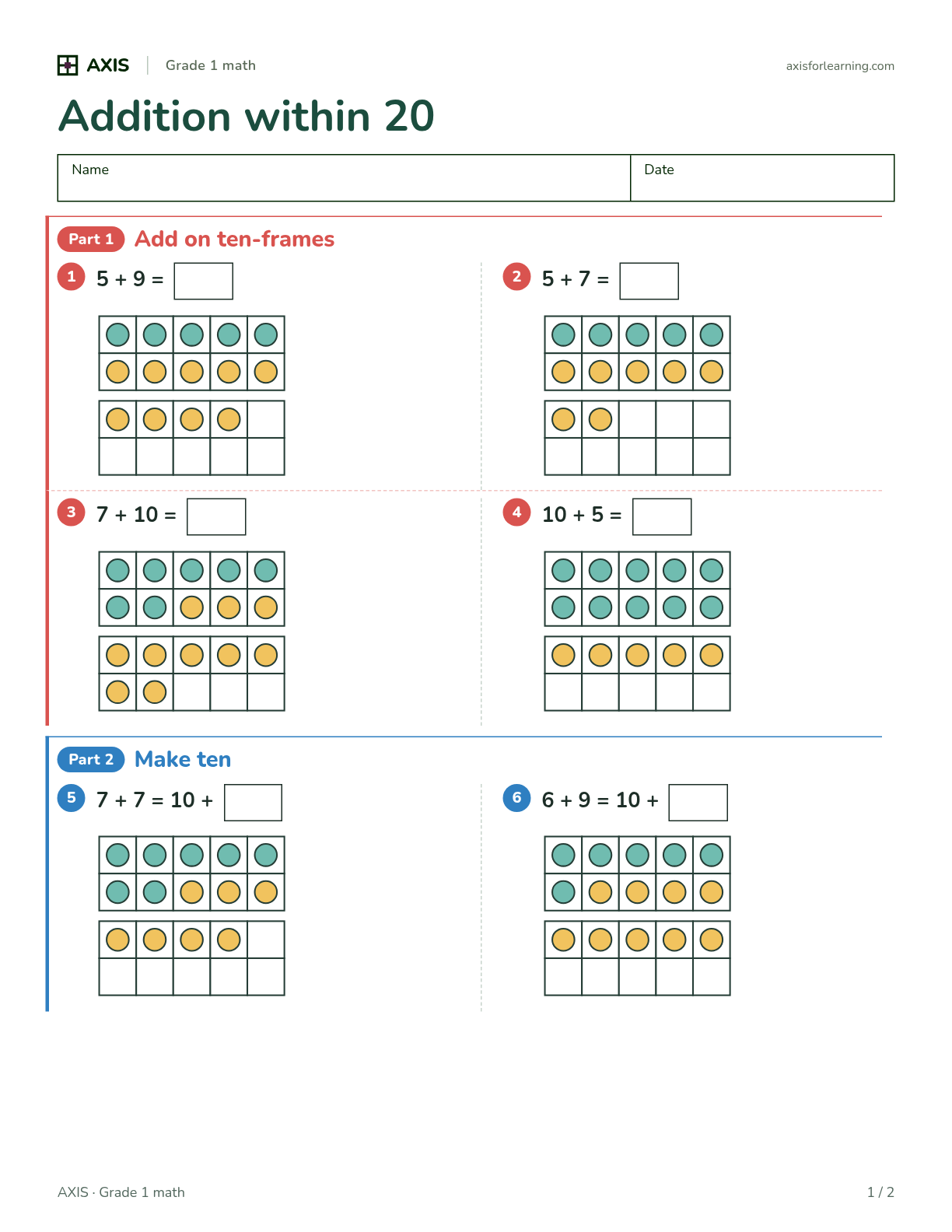
A Grade 1 addition worksheet with 14 questions in four parts, every sum between 11 and 20. Children add two numbers shown on ten-frames in two colors, make ten to finish an equation such as 8 + 5 = 10 + ▢, count on along a number line from the greater number, and add three numbers where two of them make 10. Every question has a picture that shows the strategy, and every version has new numbers and its own answer key.
What's inside this worksheet
- Part 1
Add on ten-frames
Questions 1–4. Two numbers up to 10 are shown on ten-frames in two colors, filled in order. Children write the total, from 11 to 20.
- Part 2
Make ten
Questions 5–8. An addition such as 7 + 6 = 10 + ▢ with the same ten-frame picture. Children see how many of the second number fill the frame and write the rest.
- Part 3
Count on
Questions 9–12. An addition with a number line from 0 to 20. The greater number is marked; children count on and write the sum.
- Part 4
Add three numbers
Questions 13–14. Three groups of dots, two of which make 10. Children write the total.
Curriculum objectives covered
Common Core State Standards for Mathematics
- 1.OA.C.6Operations and algebraic thinking
“Add and subtract within 20, demonstrating fluency for addition and subtraction within 10. Use strategies such as counting on; making ten (e.g., 8 + 6 = 8 + 2 + 4 = 10 + 4 = 14); decomposing a number leading to a ten (e.g., 13 - 4 = 13 - 3 - 1 = 10 - 1 = 9); using the relationship between addition and subtraction (e.g., knowing that 8 + 4 = 12, one knows 12 - 8 = 4); and creating equivalent but easier or known sums (e.g., adding 6 + 7 by creating the known equivalent 6 + 6 + 1 = 12 + 1 = 13).”
On this sheet: Every question adds within 20. Parts 1 and 2 use the making-ten strategy on ten-frames: the first frame fills to ten before the second starts, and Part 2 records it as 10 + ▢.
- 1.OA.C.5Operations and algebraic thinking
“Relate counting to addition and subtraction (e.g., by counting on 2 to add 2).”
On this sheet: Part 3 shows each sum on a number line from 0 to 20 with the greater number marked, so children add by counting on.
- 1.OA.B.3Operations and algebraic thinking
“Apply properties of operations as strategies to add and subtract.”
On this sheet: Part 4 adds three numbers where two of them make 10, the associative property used as a strategy. In Part 3 the smaller number sometimes comes first, so children start from the greater one.
How teachers use it
- Say the ten first
- For Part 2, ask children to say the sentence aloud: seven and three make ten, and three more is thirteen. Saying it helps them see the strategy, not just the answer.
- Watch where they start
- In Part 3, watch who counts on from the smaller number in questions like 3 + 15. Starting from the greater number is the strategy to praise and share.
- Fluency check
- Print a second version two weeks later and time it informally. Children who no longer need the pictures are ready for the mad minute addition sheets.
Questions teachers ask
- How many problems are on this worksheet?
- 14 questions in 4 parts on 2 pages, with a 1-page answer key at the end.
- What grade and standard is it for?
- Grade 1. Common Core: 1.OA.C.6, 1.OA.C.5, 1.OA.B.3.
- Can I print more than one version?
- Yes. There are 6 ready-made versions, each with different numbers and its own answer key, and the same version always prints the same. For more, generate a new worksheet in the generator.
- Are all the sums within 20?
- Yes. Every sum is from 11 to 20, the facts Grade 1 children learn to add with strategies such as making ten.
- Why are the ten-frames in two colors?
- Each number has its own color, and the first frame fills to ten before the second starts. Children can see how much of the second number makes ten and how much is left.
Common Core State Standards © Copyright 2010. National Governors Association Center for Best Practices and Council of Chief State School Officers. All rights reserved.
Need a different skill?
Make your own worksheet for any K–8 skill in seconds, with its answer key.