Count to 100 by ones and tens
This Kindergarten worksheet practices counting by tens to 100 and counting on by ones from a number past 20 (Common Core K.CC.A.1, K.CC.A.2).
- Kindergarten
- Counting and cardinality
- 2 pages + 1-page answer key
- Common Core aligned
- 6 free versions
Every PDF includes the answer key
16 questions on 2 pages, plus a 1-page answer key · each version has different numbers · Print from the browser
Need a different skill or more questions?
Make a new worksheet in seconds, with its answer key.
About this worksheet
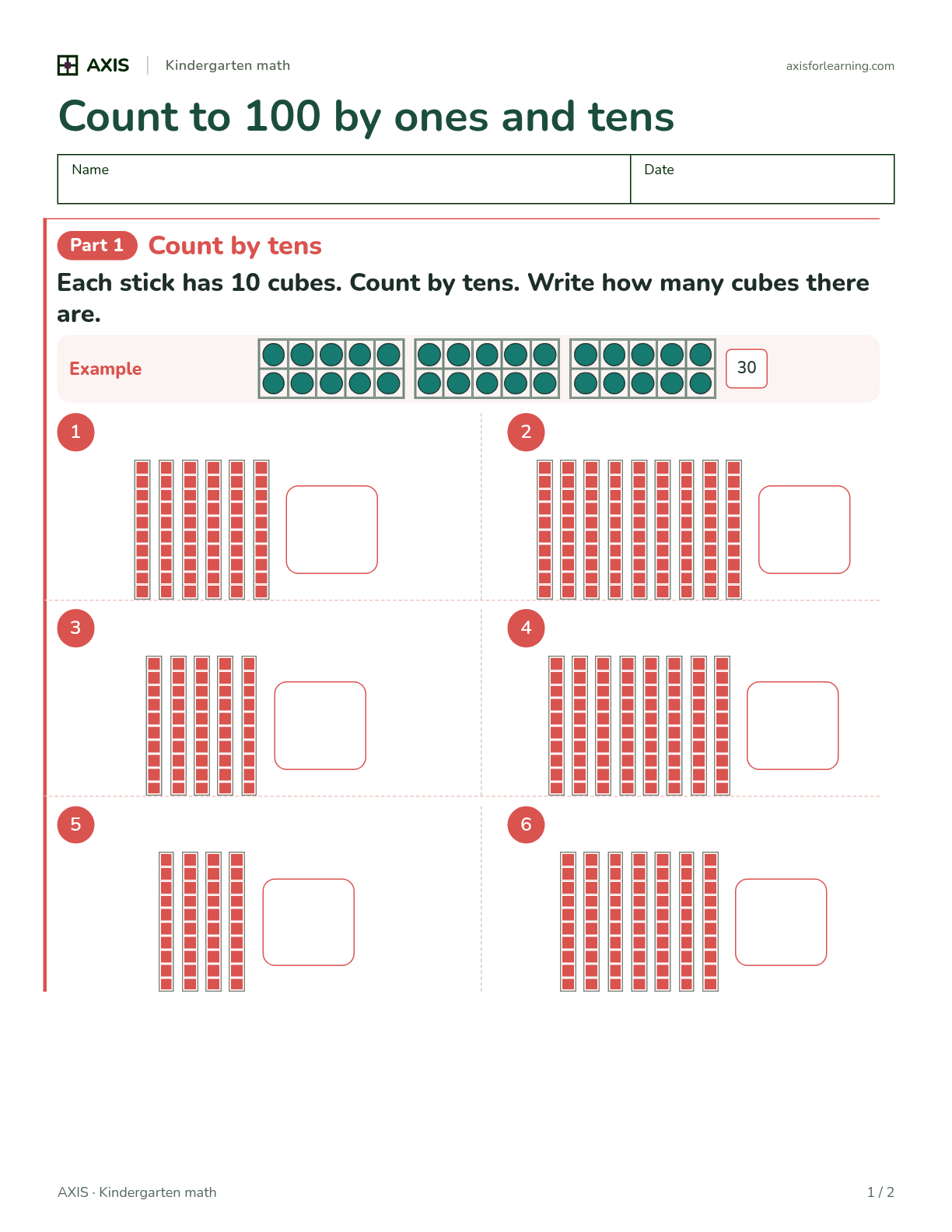
A Kindergarten counting to 100 worksheet with 16 questions in three parts. Children count sticks of ten cubes by tens and write how many, up to 100, write the missing ten in a row such as 30, 40, ▢, 60, and write the missing number when counting on by ones from a number between 21 and 99, sometimes across a ten such as 39, 40. The pictures and number rows carry each question. It prints as two student pages and a one-page answer key.
What's inside this worksheet
- Part 1
Count by tens
Questions 1–6. From 2 to 10 sticks of ten cubes. Children count the sticks by tens, 10, 20, 30, and write how many cubes there are.
- Part 2
Tens in order
Questions 7–10. Four tens in a row from 10 to 100 with one missing. Children write the missing ten.
- Part 3
Count on
Questions 11–16. Four numbers in a row between 21 and 99 with one missing. Children count on and write it; some rows cross a ten, such as 58, 59, 60.
Curriculum objectives covered
Common Core State Standards for Mathematics
- K.CC.A.1Counting and cardinality
“Count to 100 by ones and by tens.”
On this sheet: Parts 1 and 2 count by tens up to 100, and Part 3 counts by ones in rows between 21 and 99. The sheet shows the counting sequence in writing; counting aloud to 100 is worth hearing too.
- K.CC.A.2Counting and cardinality
“Count forward beginning from a given number within the known sequence (instead of having to begin at 1).”
On this sheet: Part 3 starts each row at a number past 20, never at 1, so children count forward from a given number, sometimes across a ten.
How teachers use it
- Count the sticks aloud
- Before Part 1, count real bundles of ten straws together: 10, 20, 30. Children who count every straw one by one need more bundling before the sheet.
- Watch the decade change
- In Part 3, the rows that cross a ten are the hard ones. A child who writes 50 after 49 has the idea; one who writes 410 needs a hundred chart.
- Hundred-chart follow-up
- After the sheet, cover a few numbers on a hundred chart and let children name them. It is the same skill with the whole chart in view.
Questions teachers ask
- How many problems are on this worksheet?
- 16 questions in 3 parts on 2 pages, with a 1-page answer key at the end.
- What grade and standard is it for?
- Kindergarten. Common Core: K.CC.A.1, K.CC.A.2.
- Can I print more than one version?
- Yes. There are 6 ready-made versions, each with different numbers and its own answer key, and the same version always prints the same. For more, generate a new worksheet in the generator.
- Does it go all the way to 100?
- Yes. Counting by tens reaches 100 in Parts 1 and 2, and the counting-on rows use numbers from 21 to 99.
- Why do the counting-on rows start past 20?
- Counting to 20 is on Count and show how many to 20. This sheet practices the bigger numbers Kindergarten counts to.
Common Core State Standards © Copyright 2010. National Governors Association Center for Best Practices and Council of Chief State School Officers. All rights reserved.
Need a different skill?
Make your own worksheet for any K–8 skill in seconds, with its answer key.