Compare sizes
This Kindergarten worksheet practices naming what can be measured and comparing two objects by length, height, weight and capacity (Common Core K.MD.A.1, K.MD.A.2).
- Kindergarten
- Measurement and data
- 2 pages + 1-page answer key
- Common Core aligned
- 6 free versions
Every PDF includes the answer key
10 questions on 2 pages, plus a 1-page answer key · each version has different numbers · Print from the browser
Need a different skill or more questions?
Make a new worksheet in seconds, with its answer key.
About this worksheet
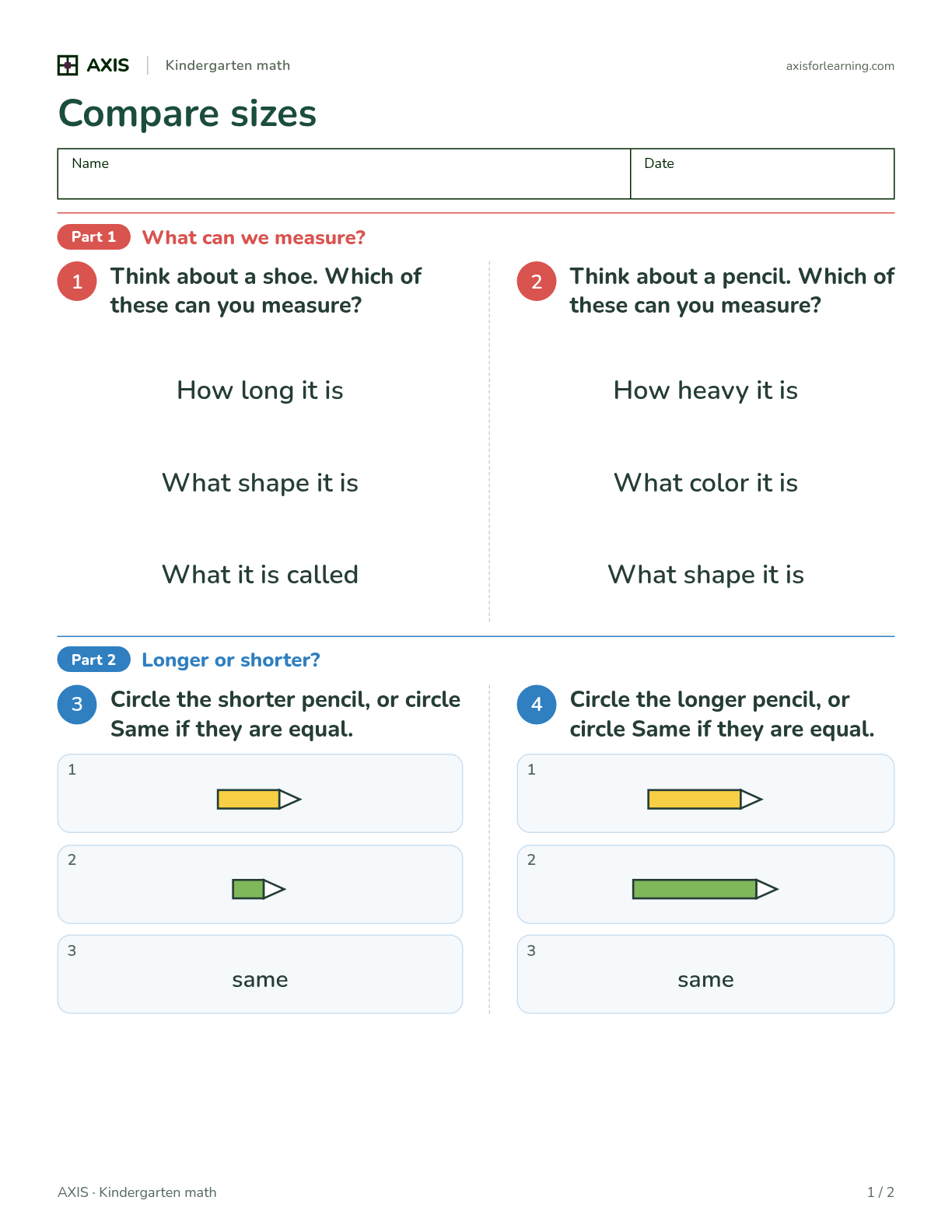
A Kindergarten measurement worksheet with 10 picture questions in five parts. Children choose what can be measured about an object, then compare two objects at a time: the longer or shorter pencil, the shorter tree, the heavier object on a balance and the cup that holds more. Some questions have Same as an answer. Each question compares one attribute, so children name exactly what they are comparing. Every version has new pictures and its own answer key.
What's inside this worksheet
- Part 1
What can we measure?
Questions 1–2. Children circle the thing that can be measured about an object: how long, tall or heavy it is, or how much it holds.
- Part 2
Longer or shorter?
Questions 3–4. Two pencils with their ends lined up. Children circle the longer or shorter one, or Same.
- Part 3
Which is shorter?
Questions 5–6. Two trees. Children circle the shorter tree.
- Part 4
Which is heavier?
Questions 7–8. Two objects on a balance. Children circle the heavier one, or Same if it is level.
- Part 5
Which holds more?
Questions 9–10. Two full cups. Children circle the cup that holds more water.
Curriculum objectives covered
Common Core State Standards for Mathematics
- K.MD.A.1Measurement and data
“Describe measurable attributes of objects, such as length or weight. Describe several measurable attributes of a single object.”
On this sheet: Part 1 asks which of three choices can be measured about an object, such as how tall a tree is or how much a jug holds.
- K.MD.A.2Measurement and data
“Directly compare two objects with a measurable attribute in common, to see which object has 'more of'/'less of' the attribute, and describe the difference.”
On this sheet: Parts 2 to 5 compare two pictured objects by length, height, weight or capacity, with Same as an answer where they are equal. Children compare pictures, not real objects.
Teaching in Alberta? The Alberta version of this worksheet follows the Alberta outcomes, with the other Alberta curriculum worksheets.
How teachers use it
- Real objects after paper
- After the sheet, give pairs two real pencils and a balance. They check one answer from Part 2 or Part 4 with objects, which the standard asks for.
- Say what you compared
- For each answer, children finish the sentence: the first pencil is longer than the second. Naming the attribute is half of K.MD.A.2.
- Lined-up ends
- Point out that the pencils in Part 2 start at the same place. Ask why that matters before children compare real objects.
Questions teachers ask
- How many problems are on this worksheet?
- 10 questions in 5 parts on 2 pages, with a 1-page answer key at the end.
- What grade and standard is it for?
- Kindergarten. Common Core: K.MD.A.1, K.MD.A.2.
- Can I print more than one version?
- Yes. There are 6 ready-made versions, each with different numbers and its own answer key, and the same version always prints the same. For more, generate a new worksheet in the generator.
- Do children measure with a ruler?
- No. Kindergarten compares two objects directly; measuring with units starts in Grade 1.
- Is there an Alberta version?
- Yes. The Alberta version of Compare sizes follows the Alberta Kindergarten measurement outcome and is listed with the other Alberta Kindergarten math worksheets.
Common Core State Standards © Copyright 2010. National Governors Association Center for Best Practices and Council of Chief State School Officers. All rights reserved.
Need a different skill?
Make your own worksheet for any K–8 skill in seconds, with its answer key.