Count and show how many to 10
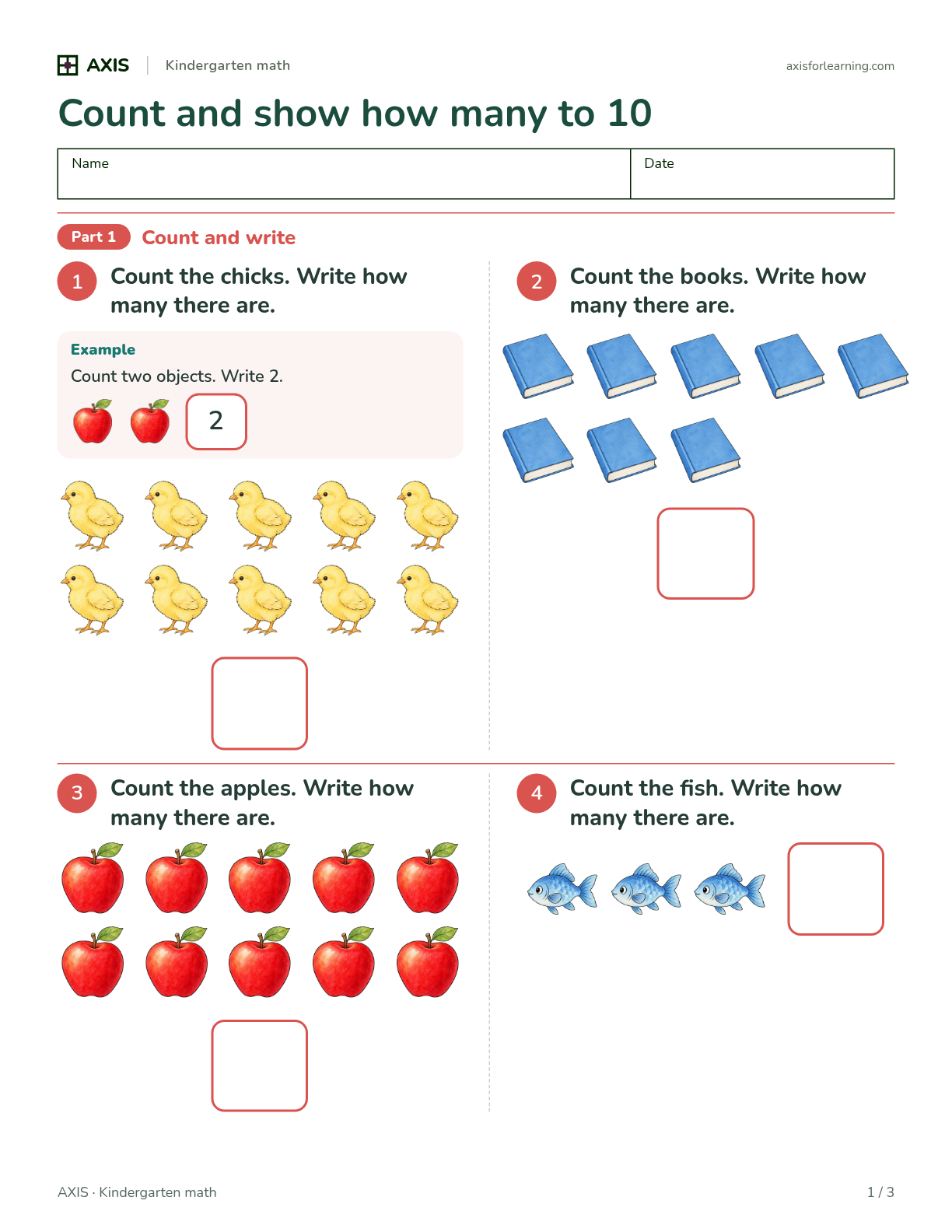
This Kindergarten worksheet practices counting groups of up to 10 objects, writing how many, matching a number to a group and comparing two groups (Common Core K.CC.A.3, K.CC.B.4b, K.CC.B.5, K.CC.C.6).
- Kindergarten
- Counting and cardinality
- 3 pages + 1-page answer key
- Common Core aligned
- 6 free versions
Every PDF includes the answer key
10 questions on 3 pages, plus a 1-page answer key · each version has different numbers · Print from the browser
Need a different skill or more questions?
Make a new worksheet in seconds, with its answer key.
About this worksheet
A Kindergarten counting worksheet with 10 picture questions in four short parts, all within 10. Children count up to 10 pictures and write the number, circle the group that matches a number, draw dots to show the number on a ten-frame, and circle the group that has more. Each question has one short line of directions and the pictures do the rest, so children who are just starting to read can work with little help. It prints as three student pages and a one-page answer key, and every version has new pictures and numbers.
What's inside this worksheet
- Part 1
Count and write
Questions 1–4. Children count a set of 3 to 10 pictures and write how many in the box. A worked example at the top of the part shows what to do.
- Part 2
Find the group
Questions 5–6. A number from 1 to 10 sits above three groups of pictures. Children circle the group that has that many.
- Part 3
Draw to show
Questions 7–8. A ten-frame shows up to 10 dots. Children draw the same number of dots in the space beside it, in any arrangement, and write how many they drew.
- Part 4
Which has more?
Questions 9–10. Children compare two groups of pictures and circle the one with more, or circle Same when the groups are equal.
Curriculum objectives covered
Common Core State Standards for Mathematics
- K.CC.A.3Counting and cardinality
“Write numbers from 0 to 20. Represent a number of objects with a written numeral 0-20 (with 0 representing a count of no objects).”
On this sheet: Children write a numeral for each group they count (Part 1) and for the dots they draw (Part 3), using the numbers 0 to 10; 0 appears when the ten-frame is empty. Numbers 11 to 20 are not on this sheet.
- K.CC.B.4bCounting and cardinality
“Understand that the last number name said tells the number of objects counted. The number of objects is the same regardless of their arrangement or the order in which they were counted.”
On this sheet: In Part 3 children draw the same number of dots as the ten-frame shows, in any arrangement they like, and write how many: the number stays the same however the dots are set out. In Part 2 the number names the whole group.
- K.CC.B.5Counting and cardinality
“Count to answer "how many?" questions about as many as 20 things arranged in a line, a rectangular array, or a circle, or as many as 10 things in a scattered configuration; given a number from 1-20, count out that many objects.”
On this sheet: Part 1 asks how many about groups of 3 to 10 pictures set out in rows. This sheet covers the standard only up to 10, not 20, and does not ask children to count out a number of objects.
- K.CC.C.6Counting and cardinality
“Identify whether the number of objects in one group is greater than, less than, or equal to the number of objects in another group, e.g., by using matching and counting strategies.”
On this sheet: Part 4 asks which of two groups (each up to 10) has more, with Same as the answer when they are equal. It asks for more and equal, not fewer.
Teaching in Alberta? The Alberta version of this worksheet follows the Alberta outcomes, with the other Alberta curriculum worksheets.
How teachers use it
- Check counting to 10
- Use Part 1 as a quick check. A child who writes 9 for a group of 10 has usually skipped or double-counted a picture, so ask them to count that row aloud while touching each one.
- Ten-frame talk
- Project a Part 3 question and ask how the class knows how many dots there are without counting each one. A full top row means five, which is the idea to draw out.
- Retest after reteaching
- Print another version a week or two later. The four parts stay in the same order and the pictures and numbers change, so you can compare the two results directly.
Questions teachers ask
- How many problems are on this worksheet?
- 10 questions in 4 parts on 3 pages, with a 1-page answer key at the end.
- What grade and standard is it for?
- Kindergarten. Common Core: K.CC.A.3, K.CC.B.4b, K.CC.B.5, K.CC.C.6.
- Can I print more than one version?
- Yes. There are 6 ready-made versions, each with different numbers and its own answer key, and the same version always prints the same. For more, generate a new worksheet in the generator.
- Does it go up to 20?
- No. Every question stays within 10: children count 3 to 10 pictures, find groups of 1 to 10, draw 0 to 10 dots and compare groups of up to 10.
- Can Kindergarten students do it on their own?
- Mostly. Each question has one short sentence of directions; read it aloud once and the pictures carry the rest. The worked example in Part 1 shows children where to write the number.
- Is there an Alberta version?
- Yes. The Alberta version of Count and show how many follows the Alberta Kindergarten number outcome and is listed with the other Alberta Kindergarten math worksheets. This page follows the Common Core.
Common Core State Standards © Copyright 2010. National Governors Association Center for Best Practices and Council of Chief State School Officers. All rights reserved.
Need a different skill?
Make your own worksheet for any K–8 skill in seconds, with its answer key.